Showing posts with label Travelling. Show all posts
Saturday, June 26, 2010
So long and thanks for the fish...
Some ten days ago, in a bar close to my old working place in the Barceloneta, I indulged into some serious dancing and partying for three main reasons. One, Greece had only won their first ever game in a World Cup on that same afternoon, two after having watched France losing to Mexico in the company of a predominantly French audience I felt we needed to be cheered up and three I was back in the company of good friends I haven't seen for quite a long time. Moreover, we found ourselves in our "natural" environment, the place where we all met, worked and have shared similar moments (that is both vivid disappointments and sudden impulses of joy) over the last years.
It was during that dancing that one of us (I was told later, it was Micha) told someone else (who was Julien): "We were a good group once"
Be it nostalgia, grief or simply "girly-talk" as my own girl put it, there is substantial truth in that. We "were" a group once, we are now individuals that used to be part of the same team, still very good friends, still in the position of meeting every now and then and have fun like we used to. As time goes by and we grow old, some things will necessarily change. And instead of thinking back in sorrow, I prefer to glance forward in joy. I am happy to realize that even though life has moved on, I can still meet my friends and have a great time with them, be it for ten days every few months. A lot of things change in between, but it is as natural, as well as desired.
As time goes by and the perception of time itself is adjusting to a more fragmentary way of "grown-up" life, I choose the most optimistic way of looking at things. Yes, we "were a group" once, but yes we also "are" still a group in a certain sort of way. And no we won't be able to celebrate all of the French defeats, (or any other kind of "defeat" for that manner) but it is quite astonishing that we manage to keep this rate of constancy of celebrating once every few months considering the distances we are all transversing in both space and time.
A few days later during a wonderful ceviche dinner at the place of a couple of friends we remembered the last time I was there. It was almost a year and a half ago, the dinner was lunch then, (but it was again fish), and my friends' precious daughter was sitting at the table with us. Seventeen months later, the precious daughter was sleeping in the room next door, with her -also precious- baby brother who was born on the same night of my last visit. As we wondered what the changes will be the next time we have dinner or lunch together, I thought that witnessing change may be as important as meeting again to share it.
As I once again rode the bus to the airport, on my way home, I promised myself I will be back soon. Not as soon though as not for some change to have taken place. It looks as if I have irreversibly connected Barcelona with the point of reference for my personal development plan ;)
So long, then, and thanks for all the fish...
Labels:
Barcelona,
Spain,
Travelling,
Work?
Saturday, June 19, 2010
Barcabios - La vuelta
So, I am back in Barcelona, as promised. It took me more than fifteen months to fulfill this -seemingly- simple promise. But things are not always what they seem to be and what has been placed between me and Barcelona over these months ended up being as difficult to cope up with as it was to let go.
So it's been one year, three months and two weeks since I took my girl, my suitcases and two backpacks full of memories on a taxi to the El Prat airport. We had had a paella and then coffee in Absinta in the Barceloneta, had said "hasta la proxima" to those friends who stood there till the end and at the door, it looked as if as even "hard" Giuseppe, my flatmate for over three years was about to cry. Then we flew back to Athens on the first day of March and the story changed so suddenly that it would be hard for one to think it's not a different story altogether.
It sounds weird that I get to remember all these details so vividly. But memories are very much like the forgotten souvenirs one brings home from a trip. You only find them once you accidentally hit on the cupboard in which you have been keeping them. In my case the cupboard is a rectangle defined by Montjuic, Gracia, Gottico and Poble Nou. And as it appears I have carelessly left something in every little corner of it, I am delighted that not a single moment passes by without me remembering, names, places and faces. A terrace in the Barceloneta where four people had dinner yesterday was enough of a reason for my being here and my coming back once more.
A couple of days ago, my good friend Kostas, suggested I listened to "Boots of Spanish Leather". As I now realize my "souvenirs" from Barcelona are something more than a pair of boots, I feel like I am at peace. It's certainly more than a pair of boots I will be bringing back home to my beloved as it's more than certain that my cupboard, with its "loyal guardians" will always be here with for me to randomly go about digging for lost, but not forgotten "souvenirs de Barcelona".
Labels:
Barcelona,
Science today,
Spain,
Travelling
Saturday, February 27, 2010
lost for words...in general
It's been quite a while since I last woke up just to have coffee and read the newspapers on the web, listening to "Ella and Louis", enjoying this blessed slowness on the advantages of which I have commented long ago. This can be seen from the density (not to mention quality) of the posts of this blog. As it often happens, the less you read, the less you are able to write. In fact, sometimes even speaking may deteriorate once you are kept away from books for long. This is more or less my case, for various reasons.
One. I am to travel to Crete once every week, where I have to either talk ceaselessly while lecturing undergraduates on Computational Biology and Programming, or bust my eyeballs in front of my tiny net-book screen while preparing the next lecture.
Two. Because of this work-travelling overload I have barely managed to read one book since the beginning of the year. A saddening output especially when compared to my prolific reading during my term in the army (which I still do not miss at all by the way). Two more books that I 've started reading through February, are still disgracefully lying on my small bed-table. Last but not least, I cannot remember the last time I entered a bookstore.
Three. Partly from guilt and partly from bad organization of leisure time, I have stopped reading on the web. That is no more newspapers, google-reader, daily news updates in four languages. All this is gone. My old colleagues will understand how big a change this is.
So, in one of this wonderfully ironic coincidences, I sat on my couch this morning to read my favourite Babelia on the web (by far the best thing being printed weekly in the Spanish language) where I came upon this article by columnist-writer Antonio Munoz Molina. Ironic, because this article somehow dealt with all of the above. Books, bookstores, talking and writing. I apologise to the non-spanish speakers unable to read this wonderful piece, for not providing a concise summary, but the truth is that it is not that easy to sum up all of the things that come through it.
The article starts with a quote by Hemingway and goes on to mention the closing of a certain bookstore in New York, then goes through a brief history of american literature of the 20th century and ends with a comparison of english and spanish in terms of verbosity, conciseness and wealth of vocabulary. All subjects I was connected to, one way or another.
One. Hemingway's mentioned quote was: "Each writer should have a built-in bullshitting detector". To which point I can already see the smiles on my ex-colleagues' faces. You see, during my term in Barcelona I have become famous for two things and these were: 1. bullshitting while talking (scientific talks included) and 2. bullshitting while writing (this blog included). Funnily enough, bullshitting got me through then and there and gets me through still through every class I have to teach. It's more of a style than an attitude and dear old Ernest can say whatever he wants.
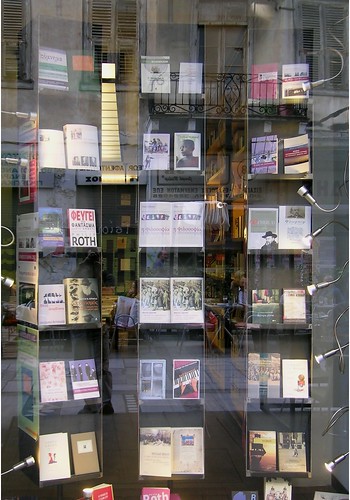
Two. The bookstore about to close is Morningside Books somewhere on Broadway and 135th (or 136th, or 137th). I have only spent two months in New York but it so happened I was living a few blocks from that place and I vividly remember spending quite sometime browsing its the old, rusty shelves. I also remember its timid, humble window, which looked nothing like the picture above, taken from a fancy Athenian book store, with more books on the display than on the shelves. Come to think of it, Morningside Books must have been the only bookstore I entered while in NYC, probably intimidated by the size of the crowds in all the huge Barnes and Nobles. As I recalled, the boxes filled with old, used Virginia Woolfs and William Faulkners I was deeply saddened to hear the place is closing down.
Three. Spanish verbosity vs Anglosaxon strictness of content. Having lived in a place where I had to use these two languages interchangeably for more than three years I can see what Molina means. But I cannot help but think how overwhelmed he would be if he were to compare them to Greek. Being in that position (even though not at the level of an established academic like the one he is) I can testify Greek to be superior in bullshitting potential to all existing idioms. The wealth of terms, ambiguities, verbal and written forms is beyond any comparison.
In fact it is so overwhelming that I suddenly realize I am not doing well in not talking (or reading) that much these last weeks. And which also reminds me I have to stop writing and go on to make some long-promised phone calls to friends that have not heard me talking for ages.
(...not that they are missing anything...)
Labels:
Art,
Journalism,
Literature,
Travelling,
Work?
Tuesday, December 22, 2009
out in the open
This is just what one needs after two months of keeping with stupid army duties, while at the same time looking for a flat (or rather sympathising with Demetra who was actually doing it). A couple of days out in the open, where one may still pretend to face nature at its purest, unspoiled form.
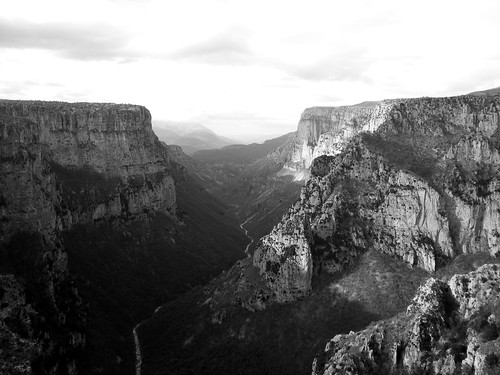
At the highlight of the trip we found ourselves, Demetra and I and a couple of friends up on the edge of a cliff with the gorge of Vikos spreading -eternal and generous- before our eyes. My current status allows no more lyricism, so I am not going to say that it has been like a revelation. No overwhelming feelings or mezmerized eyes in front of this wonderful view. Just the realization that at the side of all the superfluous, insubstantial obligations that life is burdening us with, there still exist aspects essential and genuine, that remain tangible even from the height of seven hundred meters.
Monday, August 3, 2009
ChiosBios #1
The Army starts now! (as a lot of my superiors were fond of stressing out this very morning). As from yesterday afternoon I am part of the 96th Regiment of Sanitary in the picturesque island of Chios (whose beauties one cannot appreciate from a simple look at the map but you can trust me, they 're there.)
Thanks to my very good friend Charis the habilitation process has started quite well. Still the idea of spending some four months in an environment which falls far from being considered idyllic is not very appealing. They say that one can get used to practically everything and I 've always thought of this as a really bad aspect of human nature. Nonetheless it can only prove useful in the army, where letting time pass by is all that one really needs to worry about.
I am still looking for the Holly Grail, that is a way to make army time useful. It looks tricky and has become even trickier here. But then again it wouldn't be the "Holly Grail" if it was to be that easy, would it?
Sunday, June 21, 2009
Midsummer day's dream
Last Friday after a tiring morning of doing absolutely nothing I finally got my permit to leave the barracks and come home for a short weekend. I rode the bus all the way from Arta, in the Greek midwest, to Athens on a sunny summer afternoon, trying to regain some of the sleep one inevitably loses while in the army. This proved to be more complicated than I thought mostly due to the radiant sunlight and the anticipation of seeing the people I love back home. It was going to be summertime in Athens and there are few things that can match a midsummer afternoon walk on the hill of Philopappoy before heading to Thissio for a couple -or more- glasses of wine.
As the bus was crossing the bridge that connects the Greek mainland with Pelopponese, glancing from my window, I saw the city of Patras, where I spent more than one happy years of early student adolesence back in the late 90s. A lot of nice memories came to my mind. A beach party next to the fortress of Antirrio, dinners with ouzo near the Citadel of Patras, nights out in Vrachneika. It realized that most of these nice memories were summer memories, around this time of the year when long days of study coupled with warm nights of thoughtlessness.
As the bus crossed the bridge and a two-more-hour drive laid ahead of us, I turned to the day's paper to fight boredom. There, at the bottom of the third page an air-company was advertising its new summer destination. It read: "Summer in Barcelona". I could not help smiling. Over the last weeks I had thought a lot about Barcelona, the place I left four months ago and which I had no time to reminisce ever since. Midsummer in Barcelona, with the "Fiesta de Sant Joan", nights in Barceloneta with cold "turbio" wine, sounds of jazz, and that special summer breeze cooling you down.
Then it occurred to me. That the essence of summer is exactly that. That "summer" is not a season but a place. It is THE place you want to be. It is -even more- the sum of all those places. It is the projection of all those midsummer nights in Athens, in Patras, in Barcelona, one cold evening at the edge of Yellowstone Canyon, a warm, humid night looking through a window down on Broadway Avenue, an afternoon up on Kastro in Sifnos, waiting for the full moon. Summer is that special space, the geometrical locus of all the smiles you have cast on the midsummers past.
And on the midsummers to come.
Tuesday, June 9, 2009
the works and the days
The "Works and the Days" is one of the oldest poems ever written. Its chapters contain a large number of the most popular myths of Greek Mythology. In contrast to his other great work "Theogony", Hesiod chooses the "Works and the Days" to talk about the five ages of men. Therefore the "Works and the Days" deals with the "works" and the "days" of humans, not Gods. It thus states what might now sound perfectly obvious, which is that only humans may undertake "works" and that "days" have meaning only for them, contrary to the eternal Gods who neither have a sense of the passing time and whose existence is self-contained -even if the Greek ones always had a certain tendency for "acts" ( and often rather dubious ones). In this sense, people throughout history have always been meaning to pass their "days" in strong connection with some kind of "work" to leave behind.In my -humble- case (as this STILL remains a personal blog) my "works" and "days" have been quite disconnected lately. Being in the army is the closest I can think of to being imprisoned, not just because of the obligatory confinement but mostly because of the utter boredom that the repetition of a useless life cycle brings about. In this way one has to face a paradox where on one hand the passing of time is what mostly matters while, on the other hand, the days pass with almost zero production of "work". One has to admit that there is an inherent impossibility for the conduction of any productive, constructive or by any chance meaningful task in the military environment but this only makes the frustration bigger. And which may become even bigger when it is combined with a relative necessity for work, work that cannot be carried out merely because the circumstances do not permit it.
Such were my thoughts last week when I found myself riding the bus back to Arta after a short weekend leave. In front of me lied a bunch of papers containing the comments on one of the papers I had finally managed to submit right before joining the army. And there I was, keeping notes on the margins, replying to some -often suspiciously- mean remarks, thinking over some parts of my work that could be considerably improved, accepting in the end that most of all this was quite useless. I was going back to a place where nothing of what I was thinking could be done, as there are no computers in the army (for the recruits), nor internet access (for the soldiers), or a way to download scientific papers from the web.
In the end I was simply trying to convince myself that my "works" over the last years were important enough to need some more time.
In the end I was deceiving myself with the thought that some "work" of that kind could still be done while in the army.
As I went on turning the pages, listening to Coldplay, I remembered the last time I rode a bus listening to the same album. Some one year ago on the way from Seville to Cadiz, (instead of Athens to Arta), while on holiday (instead of the army), in the company of good friends (instead of on my own), reading a nice book (instead of a paper review). I remembered that back then it seemed that all the "work" could be done in the next few "days", while now it looked like all the "days" I have are not enough, not even for a paper revision.
Most of all, it seemed like the time of the innocence had irrevocably passed by.
Labels:
Army life,
Music,
Science today,
Travelling,
Work?
Saturday, May 30, 2009
Life in the barracks

Scientifically speaking there is an easy and straightforward way for one to grasp the relativity of space-time and that is through a rigorous decoupling of its two components. If one manages to keep space constant, he allows time to clearly manifest its complete set of properties. And this is the kind of experiment I have been running for the last two weeks.
I know that living in the barracks cannot really qualify as a scientific experiment but things are sometimes better seen as something else than what they actually are. It helps. My military service is much, much more easy-going than I might have expected so there is no real reason for me to whine about something that has been suffered by almost all of my male friends. Being in the amry is no big deal. True it can be frustrating in many ways but one should stick to the positive side of things and if the military service has one such, it can be no other than the spare time it provides to the soldiers. For a 31-year old who has already changed home, job and lifestyle three or four times the mere idea that he only has to care about when to eat or sleep is radically liberating. On the other hand, it can also be close to becoming shockingly, painfully boring and in this way I had to devise a way out. My space-time experiment is the best I could come up with (for the time being).
For my first two weeks in the recruit camp of Arta I chose Thomas Mann's "Magic Mountain" to be my literary companion. I could have hardly picked anything more relevant to my situation. A young man's semi-voluntary confinement in a sanatorium on the Alps, where "nobody asks about him, and he asks about nobody". It may be somehow depressing to parallel my 9-month military service with Hans Castorp's seven years residence in Berghoff but the one thing I find we have in common is the opportunity to explore the relativity of time in its fullness. So, like Hans I found myself repeating the same routine daily, I tended to think about the importance of time and change and I hesitated on whether I should count time passing by with days, weeks or months. Like him, I am looking for ways to exploit the passing time and like him I find it difficult. Like him I have vigorously reflected on the essence of time. And unlike him I have found that if one keeps space constant, time also appears to slow down.
It thus looks like my experiment has already concluded. Which leaves me some 262 more days to think about other things.
Labels:
Army life,
Literature,
Travelling
Tuesday, February 3, 2009
a thousand days and three months

On the last Saturday of January 2006 I arrived in Barcelona after a three hour flight over a rainy and windy Mediterranean. Maria and Fernando were kindly waiting to pick me up from the airport and so around 10pm I entered the flat located on the third floor of a renovated building on Carrer de la Merce, number 6. I went to bed early as I had nothing better to do and I slept my first night in Barcelona in the company of the sound of the rain on my window. The next morning I woke up to find out the day was as rainy as the previous night. I called my parents back home to reassure them I was fine. Then I watched #1 ranked Federer win the Australian Open and spent the whole day in front of my computer. At night, I watched Isabel Coixet's "La vida secreta de las palabras" winning the Goya award for best film.
Before going to bed I posted the first ever post of barcabios, whose name was decided mostly on the availability of a term combining "Barcelona" and "bios" (which is Greek for life). It had this same photo of Parc Guell on a cloudy day on top and was entitled "Intro".
There is a number of reasons we remember some days in detail. One of them is that some days are more special than others simply because they are radically different or because they signify an event of a certain -subjective- importance. First day at school, graduation day or -for that matter- my first night in Barcelona. Another reason for this memory-imprinting is that some days assume a latent character of periodicity. They tend to be recurring, most of them annually. Birthdays, anniversaries, the final of the Champions League, or -in this case- the last weekend of January.
Comparing that weekend three months and a thousand days ago with the last one, would be of no importance or purpose if it wasn't for yesterday nights insomnia. In my desperate attempt to finally fall asleep, I ended up thinking what happened inbetween days since January 2006.
Some things never change. The last weekend was as rainy as that one back in 2006. Perhaps not as windy as then, since the wind only came one week too early this year. I still call my parents every Sunday, still to reassure them everything is fine.
A number of things have changed. For instance, instead of having nothing better to do than going to bed on Saturday nights I have to fight for my right NOT to spend the whole night out going from dinner, to concert, to party and back. It's normal. Back then I knew nobody. Today I know some people. And they are so good to me that they never stop inviting me out. Even when I am as anti-social as possible.
Other things have changed too.
Federer is no longer ATP's top seed. In fact he lost the Australian Open's final to current #1 Rafa Nadal. Isabel Coixet is now considered to be the most promising Spanish (or I sould probably say Catalan) director. Nonetheless she has done only one film in the meanwhile ("Elegy" starring Ben Kingsley and Penelope Cruz), which was not exactly great.
Barcabios has now 167 posts in addition to that distant, lonely "Intro"(ductory) one. It still has more or less the same number of readers (somewhere between three or four people I would say).
As the though came to me that the last weekend of January 2010 will probably find me in military uniform somewhere in Greece, I suddenly fell asleep.
Tuesday, June 3, 2008
Vine a Comala...
This is the opening sentence from Juan Rulfo's masterpiece, "Pedro Paramo". It translates in English to something like this "I came to Comala, because I was told that my father lived here, some guy called Pedro Paramo". The story unfolds quite quickly as the main hero, in search of his father, meets the inhabitants of Comala and as a series of logical inconsistencies slowly accumulates the reader is left to discover the secret of the village of Comala. The fact that its inhabitants are all ghosts.
Last Saturday, in the company of Julien, Eleanna and Zeynep, somewhere between Baix Pallars and Vall Fosca, I came upon my own Comala. A village called Ancs. How we got there is not a very long story. Perhaps a bit of a long drive, as Julien was trying to avoid stony bumps, dangerous mud pits and lazy cows blocking the country road. When we finally arrived in Ancs, we did not know it was going to be finally. We were supposed to be driving through it, over the mountain and towards the other side of the valley, where the rest of the company, (safe and warm in the shelter thanks to an GPS navigator) were waiting for us. But it was there, when after a good hour of tedious and dangerous driving uphill we realized that the worst part of the road still lied ahead of us as the night was slowly falling.
Wisely enough, we put half the blame on the map, the other half on our daring initiative to pick an alternative route way back and started our descent, over the same bumps and sticky mud. With the slight fear of us getting stuck up there overnight slowly dissolving after every successful turn, we started talking about what it will be living up there, in the utter desolation of Ancs. On our way past the village, we only saw a car wrecked at the side of the road and no signs of life whatsoever apart from a light on in one of the silent houses, which only half of us (Julien and Zeynep) could testify. It was then that I remembered Comala, as I had molded it in my mind while reading "Pedro Paramo" some years ago. And, even if it really isn't, Ancs looked like a ghost city to me, standing up there at the edge of a cliff, overlooking a dark valley, whose sole inhabitants are cows, their calves and the old body of car, rotting at the side of the road.
As we were cruising towards Geri de la Sal, over tarmac for the first time after almost two hours, I remembered the sight of that car, up there at the entrance of Ancs, (or was it Comala?) and tried to think of how it might have ended up there and what happened to its passengers. Then I remembered the last sentence from "Pedro Paramo".
-Voy para allá, ya voy.
(I am going over there, I am going now.)
And I felt a bit relieved as we were doing exactly that.
Thursday, January 3, 2008
a day like today
Over the past two years I have grown so used of flying back and forth between Barcelona and Athens that I can practically set my flight sleeping schedule according to the cruising altitude, knowing exactly when to bring my sit to the "upright" position before even being told. Today in particular I was quite reluctant in doing so, mostly because it was sometime around 5 in the morning when we started our descent to "El Prat" Airport.In any case, this late -or early depending on one's point of view- flight was actually better than what I expected. The weather I encountered upon my arrival, on the other hand, was not. I picked up from where I left, almost two weeks ago when it was cloudy and windy. Only now it was very cloudy and very windy. As I tried to give myself as many tasks as possible to avoid going to bed at 11 am, I found myself riding a bike up on the Rambla only to remember that a day like today, four years ago I was walking down the same street for the first time in my life. Back then in 2004, Barcelona was just a -promising- holiday destination, I was a tourist and in the company of Kostas enchanted by this beautiful city. Today, I have been in this place for almost two years, enough not to consider myself as a "guiri" anymore. Nevertheless, the joy of walking down the Rambla remains unspoiled by any habitual interference, like having to go to the supermarket or carry 10 kilos of groceries back home, while "bicing" (yes, I still do that) through the tourist-infested streets of the Gotico.
It looks like, 4 years after that first acquaintance with the city of Gaudi, the magic is still here.
Tuesday, December 25, 2007
Where is home?

Bloc Party, wonder about it, maybe less than I do. Where it is? Where is home?
Late Friday night, the bus from the airport takes me through familiar avenues, sites of a seemingly distant everyday commute, towards the center of my favourite birthplace, which could be the most beautiful city in the world, -and perhaps at some point in history actually has already been. As we go down Vasilissis Sofias Avenue, I become aware of what never left this place. People eager to party 24 hour days without being separated from their cars are infesting every small street from here to Syntagma Square at 4 am!
In front of the Parliament I step off the bus and take a deep breath of the thin, dry air of my old capital. I am home.
But am I really? As I walk down towards Ermou Street to catch a taxi home I run across young people coming out of the nearby bars which are closing down. They all look so elegant and happy, dressed up with smart and expensive clothes. Most of them are maybe 10 years younger than me but make me look like a high-school student with my anorak and my hiking boots and the backpack I am carrying around. I get a feeling my compatibility with Barcelona is starting to become incompatible with my hometown. And as soon as the youngsters, all fun and laughter, rush by me to get a taxi before me, this feeling gets stronger. I stand there, suitcase in hand, as they pass me by with the most naturally innocent way and then I cannot but wonder. Am I a tourist in my own city?
Three days later, I have still not gone out that much. I am spending time with friends and family, mostly because it is them that mean home to me more than anything else. But I still wonder whether I am staying in because of a fear -or to put it milder, an anxiety- to face reality. Starting from tomorrow I 'll try to get as much more of AthensBios as I can, just to make sure, that even if I cannot undoubtedly state where home is, Athens is still part of it.
Tuesday, October 30, 2007
Found myself in France...lost in translation
A last minute trip that turned out to be a great experience. It all started when Roderic (my rather easy-going boss) asked me to replace another colleague (Tyler) in a meeting to be held in Lyon. And he did it on such a short notice that even I (the ever-organized-travel-freak) had no time not even to check the exact address of my hotel.I arrived in Lyon after an 8 hour train journey, only to realize that I had crossed multiple borders in space and time. Because apart from being in France and not in Catalunya anymore, I also found myself in the middle of the winter instead of the mild Barcelonian autumn. Still, adoring the view from the hill of La Fourviere was totally worth it.
What is the main reason for this post though is not Lyon, its two beautiful hills, its two marvelous rivers and the extra-heave local food specialties (try getting the full menu in a typical "bouchon lyonnais" and then sleeping...). Apart from admiring all that, I had a lot of time to spend with francophone people, practicing my otherwise poor french and realizing the beauty that lies hidden not in the differences of idioms but in the profound depths of our universal language itself. Meaning this ability for superposing multiple layers of meaning on an apparently simple structure.
It was on the train to Lyon from Montpellier while browsing last week's Courrier International, when I read this incredibly surrealistic piece of news. The Brazilian Minister of Interior Affaires had just banned the use of the gerund among the civil servants of the state! Clerks, secretaries and even directors were no more allowed to use everyday phrases like "I am working on it", or "we are looking into your problem" so that they do not give the false impression of escaping work by pretending to be doing it! It came as the first clue. Words have a meaning and the language is meaning.
But then, as I kept browsing a bit more, I came across an article about my hometown, Athens and one of its greatest problems, pollution. It was then, in the french translation of a greek article that the sound of my own mother tongue struck me. The Athenian smog, with all its carbon monoxide and ozon was left un-translated and referred to in its original greek term "νέφος" (in the text "nefos"). Suddenly I felt like the article was no more talking about the common smog, a polluting-meteorological phenomenon, but rather about a mythological monster attempting to devour a city cursed by its ancient god-protectors. It is in such cases that language apart from meaning something obvious, is at the same time inflicting a feeling.
Two days later, while spending my time at a bookstore in the center of Lyon, waiting for dinner, I bought "Feux", a collection of short stories and poems by my favourite Marguerite Yourcenar. Since it was still early I started reading it a bit but stopped only at the first phrase. "Je veux que ce livre ne soit jamais lu" (I want this book to be never read). This contradiction, so straight-forward and naive that sounds almost childish reminded me of the opposite declaration, once stated by Borges, according fact that he chose never to write a big novel because he thought the worlds is more in need of readers than writers. I sat back seeping my espresso and could not help but smile at the way the masters of verse use the language beyond both meanings and impositions, achieving an even higher meta-level, whose main inhabitants are ironies, metaphors, allusions and references.
And then I thought that compared to understanding all this, french should be a piece of cake.
Friday, September 21, 2007
Vaixell de Grecia
Once more a greek-catalan connection, coming from a Lluis Llach song. Despite of my being discouraged of listening to catalan songs by readers of this blog I keep catching up with the discography of this very interesting guy (the first citizen ever to take a prime minister to court for not keeping his promises...). At the same time I get very interested into his lyrics, especially when I see that quite a few of them are full of references to Greece.
Over the last days, basketball, football and (thirdly) work have not left me enough time to appreciate some really nice verses of some even better songs, but with the long weekend coming up and a local holiday approaching, I spared me a moment to do some research on my one and came up with an obscure philellene named Loukianos Trochiforos which has actually translated one of Llach's songs into Greek. The name of the song is "Vaixell de Grecia" (meaning Greek boat) and Trochiforos' translation is relatively free, (judging from my poor catalan). In any case I post it here with apologees to non-greek readers.
"Αργοναυτες"
Κατω απο τ'αστρα, που λεν στους ναυτικούς
για συμπληγαδες και τοπους μυστικους
διχως πυξιδα κι οι φαροι μακρια
ορθοι στην πλωρη, μα πουθενα στερια
Αλλου οι γοργονες, τα κατασπρα νησια
και των γονιων τους τα περγιάλια τα κρυφα
Τουτοι εχουν ροτα για του κοσμου την κορφη
και τα ονειρα τους, του Πρωτεα τη μορφη
Κι αν πεταλιδες τρυπουν τα στεγανα
κι αν η αλμυρα σαπιζει τα κουπια
μ'ενα τραγουδι φουσκωνουν τα πανια
κι ας περιμενουν φουρτουνες στα Στενα.
Labels:
Barcelona,
Literature,
Music,
Politics,
Travelling,
Work?
Monday, September 3, 2007
Earth, wind and fire...

this summer was supposed to be something different from what it turned out to be.
I hoped for cool waters and summer breeze and I saw too much of dry earth and burning wood. I was longing for the smell of the salty sea but got dust and ashes instead. I was hoping for fun and laughter but got blue mood and grey faces.
Life is like this. It does not always give us the expected. And the four weeks I spent in Greece were at a large part a sad reminder. Not that there were no nice moments. During my stay I witnessed the wedding of a very good friend, (and maybe danced too badly while celebrating it, so badly that people had to throw water on me to make me stop). I had the chance to visit the south of Crete for the second time in my life (to be once more reassured of the special beauty of the place and the kindness of its people) and did not miss the opportunity to revisit familiar, favourite places in Sifnos, meet with old friends and make some new ones. I had the chance to spend some time with someone I love, verify what keeps us together, realize what stands between us and stick to the first.
But the good moments end there...
At that point this weird August, filled with flames, hot winds and bad news, started its charge. As the phone kept ringing with an absurd frequency bringing news of sickness and loss, the screens started their own bombardment of televised catastrophes, villages in flames, people perishing and ...finally Ancient Olympia caught in the midst of this burning hell.
It was then that we all find it hard not to crack. Because one may handle the destruction of objects and the decline of moral, one can even suffer lightly the human loss, but he cannot stand the destruction of the symbols, the decay of the living memory and the loss of his identity.
They say general Makriyannis, one of Greece's heroes of independence once stopped some local chieftain trying to sell antiquities to the British in exchange for guns. And when the chieftain told him that the guns were needed to keep up the fight for a free country, Makriyannis told him that these same antiquities were what they were fighting for, these ancient pieces of marble, that cannot be reborn or sprang out of the earth, were the free Greece they were dreaming of. And that without them there was no need for struggle or fighting.
The marbles of Olympia were saved, although only at the last moment. Thus there is still reason for battle and struggle.
A day like today, Makriyannis forced the King of the young, independent Greece to grant constitution to its people. The brave, stubborn general kept fighting until the end for a better place for his children. Let us follow his example.
Sunday, July 29, 2007
ViennaBios - Lessons from a conference
I spent last week in Vienna, the last destination of a series of travels this semester, before heading back to Greece for the holiday. The official excuse, was the ISMB/ECCB conference (which will be understood by bioinformatics geeks only but seriously the rest of you do not need to know!) And amazingly enough the conference was indeed the place where I spent most of my time while awake. Apart from its huge size in all aspects (participants, parallel sessions, exhibitions, 1000 posters etc) it was particularly interesting in a a number of ways, not all having to do with Science. I 'll postpone writing about Vienna for another post (or maybe another journey) and stick to the lessons a young (and lets admit only marginally promising) scientist can get from a conference.
Lesson #1: (As in most sectors of human activity) the people who really matter are most likely the ones who have been around for quite a while.
They are in general under-dressed, have awful haircuts, horrible powerpoint slides (they actually do not use overhead projectors because they are not allowed to do so) and use old-fashioned vocabulary. They are also wiser, wittier and more clever than the average speaker, they do not talk crappy-fashionable-scientific-voodoo-buzz-words all the time, have a wide knowledge of the problem they are dealing with, are more interested in questions than in answers, finish their talks with more criticism than perspective, use the language in a better way. Strangely (or not) they tend to have a totally different background than most of the attendants of the conference. Not surprisingly they have little or no impact on young researchers who carry on doing their thing...
And that is the non-optimistic lesson!
Lesson #2: Class battle exists in science
I had the chance to attend two talks by the same person given on the same day, on the same subject, to different audiences. the first one opened with an impressive introduction, carried on under flashes of photo cameras and ended with the presentation of an award for the speaker, which -as the organizers kindly informed the puzzled audience- left no time for questions. A couple of hours later, the recently awarded young scientists had to face a wave of criticism and really hard questions from a suspected audience who did not really care about awards or not forming part of this special cast of awarded, or invited speakers. To me it looked that what was was under criticism was, apart from the presented work, the whole system of evaluating scientific work through impact factors and k-indexes. It appeared that a great majority was somehow pissed at being steered by an arbitrary, self-acclaimed, scientific avant-guard, which decides what is worth it and what is not, not only when it comes to scientific answers but -and that is dreadfully WORSE- scientific questions as well.
To the unsuspected, innocent young post-doc I am, it really looked like scientific class battle of the best kind.
And that was the optimistic lesson!
Labels:
Science today,
Travelling,
Work?
Wednesday, July 18, 2007
Roots...

I guess the post titles ending in "..." are supposed to add a sort of nostalgic, hanging-in-the-air feeling to it, but you may be right if you think it is becoming tiring.
...however...
(here we go again!)
A long, sighing "anyway" before moving on, and that is in all possible ways. Over the last week, I have been talking with people on the phone, reading their blogs (or their comments in mine), or discussing with them directly and I got the same feeling from practically everybody. They all need holidays. Either from having worked too hard these last months, having been bored to death or simply because it's summer, in any case people are starting to think of the sea much more often around this period, at least on this side of the planet.
Moreover, and without any loss of generality, we can certainly argue that the geometric locus of the exiled Greeks' dreams is, and will always be, the Aegean Sea (and who ever dares can try to prove me wrong). Nonetheless, I don't think it's so much being tired (the case for most) or lazy (my case) for longing Sifnos, Crete or Schinousa. I 'd rather say it has to do more with our roots than with our mood or stamina. And our roots, whether we want to admit it or not, are inextricably weaved with the pines at the seashores of our childhood, buried in the sand of our teenager holiday beaches, or floating at the edge of the deep green sea of our youth. More prosaically, we need to go back in time, more than in space. And since (as an elderly wise man like Eric Hobsbawm puts it) the past is a different place, we still consider going back as a journey.
I felt his clearly only ten days ago, standing at the shore of this lagoon in Vivari, close to Nayplio, the place where I have spent a number of my childhood summers and which I have been visiting unstoppably ever since. Yes, the past is a different place, but let's admit it, it is a nice place to visit every now and then. On the other hand, no one can convince me that we are living lives so miserable or unworthy, for "nostalgia" to be the only way out.
In the end, for all you Greeks out there, the meaning of "nostalgia" itself (αλγος του νοστου) is actually the "pain of returning home" and this is exactly how Homer meant it. The fact that coming back almost always means also going back in time and this is -most of the times- painful. But what the hell! If after an unknown number of massive cataclysms, the rise and fall of a hundred empires and numerous scientific revolutions we still remain as much of a "masochist" as Ulysses, then -Zeus damn it!- it must mean something. And paraphrasing Kavafis, it may be worth even longing for the journey...
(and there you have them again, these three dots in the end)
Sunday, June 24, 2007
Oh what did you see my darling young one?

So it is official! After a month and a half on the other side of the Atlantic, this different, fascinating world, full of marvels and contradictions, I am back in good old Europe.
These last six weeks have been intense to say the least, providing food for thought on many levels apart from real, good-friend, traditional fun, especially during the last days. But on these last days, spent in Yellowstone Park, I'll try to come back soon. For now I can only bid farewell to the USA and since six weeks is too much time to allow me to go into detail, I will just try to put everything plainly but at the same time lyrically in the style of the great Bob Dylan, trying to condensate images, sounds and thoughts in a handful of verses.
So let's go...
...[
Oh, where have you been, my blue-eyed son?
Oh, where have you been, my darling young one?
I've ridden a steel bird all over the ocean
I've stood on the shore of the opposite side
I've strolled all along in the yards of old legends
I've walked all the way to get out of their shadow
I've drifted away where the time is forgotten
And it's a hard, and it's a hard, it's a hard, and it's a hard,
And it's a hard rain's a-gonna fall.
Oh, what did you see, my blue-eyed son?
Oh, what did you see, my darling young one?
I saw an old man forced down by his name
I saw a blind mob hurraying in the vacuum
I saw the big city lights, they were glowing for no one
I saw people running, with nowhere to go to
I saw people standing, wishing they could fly away
I saw the great wide open, it looked like it was narrowing
I saw the steep canyons and they looked to be widening
I saw ten million travelers and they were all taking photographs
I saw ten million photographs and they all looked the same
And it's a hard, and it's a hard, it's a hard, it's a hard,
And it's a hard rain's a-gonna fall.
And what did you hear, my blue-eyed son?
And what did you hear, my darling young one?
I heard "hello" and "goodbye" and they both had not meaning
I heard "Godspeed" and "farewell" and they both sound real
I heard the "welcome" at last and it made me wonder
I heard the clapping of hands echoing nothingness
I heard ten thousand cars all honking their horns
I heard ten thousand horns instead of ten thousand screams
I heard the radio shouting and the TV mumbling
I heard the people's silence, so sad and so lonely
I heard the sound of the thunder again and again
And it's a hard, and it's a hard, it's a hard, it's a hard,
And it's a hard rain's a-gonna fall.
Oh, who did you meet, my blue-eyed son?
Who did you meet, my darling young one?
I met a living legend and he let me down
I met ordinary people and they lifted me up
I met an elderly woman, she was crying at the bus stop
I met an old guy worrying and people thought he was crazy
I met a young, crazy girl and she was worried about nothing
I met a working-class girl, looking outside the window
I met Asians and Arabs and Greeks and Americans
And they were all going around as if nothing was happening
But it's a hard, it's a hard, it's a hard, it's a hard,
It's a hard rain's a-gonna fall.
Oh, what'll you do now, my blue-eyed son?
Oh, what'll you do now, my darling young one?
I'm a-goin' back out before the rain starts a-fallin',
I 'll walk through the streets of an old, forgotten continent
I 'll swim across all the seas of my ancient country
Where the people each talk their own different language
Where the sick and the healthy are still liking each other
Where the blacks and the whites still work next to each other
Where the sun may still shine while the clouds are a-gathering
Where they all are somebody but they want to be nobody
Where they all want to be someone they are not
Where the world rules the money but it's starting to change
And I'll see it and think it and speak it and laugh at it
And I'll watch over the shore as the ships will be leaving
Like the old times when people still had a dream and a hope
And I 'll stay there until the ships start a-coming
And the people with dreams come back with their hopes
And the people with hope come back with the dreams
'Cause we need them and their dreams and their hopes and their coming
'Cause it's a hard, it's a hard, it's a hard, it's a hard,
It's a hard rain's a-gonna fall.
]...
get the original song's lyrics here
So let's go...
...[
Oh, where have you been, my blue-eyed son?
Oh, where have you been, my darling young one?
I've ridden a steel bird all over the ocean
I've stood on the shore of the opposite side
I've strolled all along in the yards of old legends
I've walked all the way to get out of their shadow
I've drifted away where the time is forgotten
And it's a hard, and it's a hard, it's a hard, and it's a hard,
And it's a hard rain's a-gonna fall.
Oh, what did you see, my blue-eyed son?
Oh, what did you see, my darling young one?
I saw an old man forced down by his name
I saw a blind mob hurraying in the vacuum
I saw the big city lights, they were glowing for no one
I saw people running, with nowhere to go to
I saw people standing, wishing they could fly away
I saw the great wide open, it looked like it was narrowing
I saw the steep canyons and they looked to be widening
I saw ten million travelers and they were all taking photographs
I saw ten million photographs and they all looked the same
And it's a hard, and it's a hard, it's a hard, it's a hard,
And it's a hard rain's a-gonna fall.
And what did you hear, my blue-eyed son?
And what did you hear, my darling young one?
I heard "hello" and "goodbye" and they both had not meaning
I heard "Godspeed" and "farewell" and they both sound real
I heard the "welcome" at last and it made me wonder
I heard the clapping of hands echoing nothingness
I heard ten thousand cars all honking their horns
I heard ten thousand horns instead of ten thousand screams
I heard the radio shouting and the TV mumbling
I heard the people's silence, so sad and so lonely
I heard the sound of the thunder again and again
And it's a hard, and it's a hard, it's a hard, it's a hard,
And it's a hard rain's a-gonna fall.
Oh, who did you meet, my blue-eyed son?
Who did you meet, my darling young one?
I met a living legend and he let me down
I met ordinary people and they lifted me up
I met an elderly woman, she was crying at the bus stop
I met an old guy worrying and people thought he was crazy
I met a young, crazy girl and she was worried about nothing
I met a working-class girl, looking outside the window
I met Asians and Arabs and Greeks and Americans
And they were all going around as if nothing was happening
But it's a hard, it's a hard, it's a hard, it's a hard,
It's a hard rain's a-gonna fall.
Oh, what'll you do now, my blue-eyed son?
Oh, what'll you do now, my darling young one?
I'm a-goin' back out before the rain starts a-fallin',
I 'll walk through the streets of an old, forgotten continent
I 'll swim across all the seas of my ancient country
Where the people each talk their own different language
Where the sick and the healthy are still liking each other
Where the blacks and the whites still work next to each other
Where the sun may still shine while the clouds are a-gathering
Where they all are somebody but they want to be nobody
Where they all want to be someone they are not
Where the world rules the money but it's starting to change
And I'll see it and think it and speak it and laugh at it
And I'll watch over the shore as the ships will be leaving
Like the old times when people still had a dream and a hope
And I 'll stay there until the ships start a-coming
And the people with dreams come back with their hopes
And the people with hope come back with the dreams
'Cause we need them and their dreams and their hopes and their coming
'Cause it's a hard, it's a hard, it's a hard, it's a hard,
It's a hard rain's a-gonna fall.
]...
get the original song's lyrics here
Labels:
Barcelona,
Literature,
Music,
Politics,
Travelling,
Work?
Saturday, June 9, 2007
BostonBios - is this not America?
Paraphrasing David Bowie the day begins as the working week is ending. I start walking on Brighton Avenue with Beth Orton singing "Comfort of strangers", as I am still as much of a stranger as I feel strange after a whole month in the US. The streetcar slowly slides on Commonwealth on our way to Boston University, the sun is making its shy appearance behind New England's thin but almost permanent cloud layer. Boston University Central, I am starting to think about work and no comfort is to be found in any song. Over the past few days I have gone from worrying that work is not going well, through doubting about my aptness in it, to finally realizing that something is going wrong. Still hanging on through one of the, seldom, self-esteem panic attacks that took me over two days ago, I pump up the volume of the Rolling Stones as the streetcar approaches Blanford Station. "All down the line", this is where I get off.
As I sit myself at the desk, getting my laptop out of my backpack, I am still thinking. Is this what I was hoping for in the US? Tough call. A great city, some of the finest minds of science strolling on the same sidewalks, ambitious students trying to cope with inspiring professors, all seems to be here but something is still missing. Is it me that is not fit for this or am I still having trouble to conciliate with the nature of research? Is something really going wrong or have I just lost my calm, placid, philosophical approach to scientific work? And if it is so, what is wrong with me? Have I lost it?
I see all these people constantly talking about science, perpetually overwhelmed by their ideas or struck by the lack of them, astounded or frustrated by their results. Distraught in their small, isolated worlds, where a protein may be more important than summer coming, or a plot more meaningful that the full moon. It suddenly hits me. Where has the fun gone? I check my e-mails and amazingly feel homesick for a place, where I have only lived and worked for less than a year and a half. I watch the video of my colleagues back in Barcelona, celebrating the first anniversary of the new institute building and there I realize that fun somehow is an endemic species of the Mediterranean.
The day goes on, void of serious thoughts, with unimportant results filling the vacuum. Around five I am the only one left in the lab, alone in front of the screen with John Coltrane's sax and Eric Dolphy' s flute, keeping me the kind of company you can only appreciate when lonely. I am still having trouble believing how everybody is gone so early. I always had the idea that people in the US work crazy hours. But on second thought and given that I haven't heard a single joke (let alone a laughter) in the lab over these three weeks, I can understand why everyone is so eager to leave early. This is a strictly working place. We take positions early in the morning, make it through our shift with our headphones on and head on home with relief as soon as possible.
Gandhi once said that "what we do is not important, but it is important that we do it". I just hoped one of the things for which Gandhi died would be that some of us - maybe still a few but hopefully soon to be more - would also be able to enjoy part of what we are doing. If not, at least try to make it this way, mixing everyday work with the real life, the laughters, the irony, the feeling that you are sharing the desk with other people and not just "scientists", with whom you can also talk about football, rugby, women (or maybe men), music instead of just "false positive rates". Coming from a country that does not deserve any merit in science and research for the last two millenia, I find it hard to believe that I ended up even reminiscing my lab days in Greece, where we had no subscriptions to journals, fast internet or air-condition that actually worked. At least there, you would walk down the hall and people would say. There you would take your breaks talking about sports or politics to the people next door.
I shut down my computer, lock the door and make for the elevator. On my way I say "goodbye" to the cleaning-guy who looks surprised. He has still not been used to me being the only person on the floor talking to him. But then again, I still find it hard to see people looking the other way when I say "hi" upon meeting them on the corridor.
This is not me complaining. It's just me realizing.
Realizing that I have a great job and realizing that it is great not because of its nature but because me and my colleagues have fortunately decided it should be made in one specific way. That is the Mediterranean way, the fun way.
Tuesday, June 5, 2007
BostonBios - Fog Warning

It is not only lately that my mood is highly correlated with the weather. But these last days have been something else. We somehow passed from warm, humid (in the absolutely literal sense)Saturday night to wake up on a chilly Sunday morning to go through a melancholic Sunday afternoon pouring with rain. And today I woke up in a hurry to get to the lab meeting to find myself lost inside the fog in the middle of Commonwealth Avenue. The air was so stuffy and humid, that although it was not raining I was actually walking through droplet of water and there appeared to be rain falling horizontally, if not floating in the air.
I just decide it was one of these Monday mornings, that they can also happen on this side of the Atlantic and that this foul, morning mood, combined with the bad weather and the beginning of a working week, signified a rite of passage for me eventually realizing that after some weeks even being 3000 miles away from the office can still mean working routine.
Apart from all that maybe it is better that this weather continues. The summer is only starting and all I can think of is sunny days, the sound of waves and the taste of salt mixed with white wine on my lips. And it is funny how sometimes we realize that we need unpleasant atmosphere to bring us back on the ground. The New England fog and the horizontal rain saved the day, putting my butt on the desk.
Apart from all that, life in Boston is evolving somehow in parallel with reality. Ever since I got here I have left behind a number of everyday activities such as reading the papers or following the news in general. My only connection with what is going on in this country has been watching the next to last Eastern Conference NBA semifinal at a bar in Allston last Thursday. In fact I have no idea of what is happening in the USA, or to put it better what are the issues that are concering the people here. This lack of information has not disturbed me yet although maybe just checking the weather forecast sometimes might save me the trouble of waking up surprised to a foggy day.
Subscribe to:
Posts (Atom)