Showing posts with label Art. Show all posts

Friday, May 6, 2011

the man who ran a lot

When I was a little boy, two things were very common on Saturday nights. One, my parents, still quite young and too tired of staying in the whole week, wanted to go out. Two, the Greek TV, still in its innocent youth was overwhelmed with old Greek comedy films, most of them shot during the 50s and 60s. The two combined meant that I had to spent a great number of my childhood's Saturday evenings watching Greek comedies at my grandparents place in the -then- quiet and picturesque neighborhood of Gazi.

There was one more thing. Back then, I could not stand Greek films. Oddly enough for a child at my age (these evenings were more frequent at the age of 5 to 10), I had the greatest distaste for these naive -I then thought- productions that could simply not compare to the historical Hollywood feature films like "Spartacus" or "Lawrence of Arabia" that were my father's favourites. Even more strangely, I could not stand colour. I vividly remember having a strong preference for black and white films, which to my eyes appeared more original, as I found it hard to accept that technicolored, cinecitta-like, musical extravaganzas had anything to do with Greece in the 60s. To my childish eyes -and as it now seems to the eyes of most people-, Greece in the 50s and the 60s was a black and white place, poor but romantic, grey and nostalgic.

Among those black and white films, there was only one kind I really LIKED to watch (to the relief of my grandparents). Those starring Thanassis Veggos. Aka our "good man". Aka "the man who used to run a lot". Truly the most talented Greek comedian of all time, undoubtedly the most innovative, simply the most beloved actor in the (short and moderate) history of Greek cinema. There was that time, I still remember, when Veggos was on, that everything stopped. At the age of 7, I could not get all his lines and I was puzzled by some of his references to anti-military themes, but there was something in this man's voice, his constant running up and down, his overall struggling that to me was -subconsciously- identified with the Greek soul.

To my childish eyes, THAT was Greece in the 60s. A guy in black and white, always in a working-class neighborhood, obviously uneducated but curiously wise, working three or four jobs to get by. A guy who never gets rich, never gets the pretty girl, never gets to be famous. Yet a guy with a smile that cannot be beaten, a laugh that cannot be silenced, a face impossible to be forgotten.

The "man who ran a lot" reached the finish line last Tuesday. Given that our Greece today is starting to resemble that black and white country his films took place in, there is a growing demand that we live up to his effort.
After all, life is a relay race.

Wednesday, December 8, 2010

the last stand


Of late I have re-newed my devotion to Thanassis Papakonstantinoy mostly due to the interest epxressed by my good friend J. upon listening to a track of Thanassis, which I had casually posted on my facebook page. After giving J. a brief introduction and urging him to listen to "Vrahnos Profitis" (one of my most favourite Greek albums ever) I also found myself unconsciously pressing "repeat" over some of the tracks of the album.

This is how I got to remember "A. Manthos" (the album's fourth track and one with very particular lyrics) and how I came up with the story behind it. The song's lyrics have been adopted from a poem by Christos Bravos, referring to a real incident between Athanasios Manthos, a photographer of the town of Trikala and Thomas Gandaras, an infamous bandit of the region of Thessaly which took place in the 1920s. Gandaras had an extremely bad reputation among the great land-owners of the region for having an extensive record of kidnappings and killings, but as these were limited against the rich and the powerfull, the poor people were largely sympathizing with him. The legend had it that Gandaras became an outlaw in order to avenge the rape of his wife by a squire, thus he and his gang were more often thought of as "Robin-Hood"-like bandits instead of as fierce killers.

But authorities thought (as usually) otherwise and soon the head of Gandaras was put a price on. As the manhunt was closing down on him and his men, he realized that it was not meant for him to last long. Before his last stand, he wanted to strike a last pose. He decided to have his photo taken. One night, he
forgot all precautions and sneaked into the house of Manthos, by then a well-known photographer in the town of Trikala and the nearby villages. Manthos woke up in awe as the ruthless bandit stood before him but was relieved to find out that all the the outlaw wanted was his portraid done. Thus in the middle of the night, Manthos, who was used to photograph weddings and funerals, took a photo of the famous Thomas Gandaras in the living room of his house and in outmost secrecy. The story of this secret meeting is told in the aforementioned poem "A. Manthos" by Christos Bravos, has been made a song by Thanassis Papakonstantinoy and was recently the subject of a beautiful short film by Vassilis Kosmopoulos entitled "The Trikala photographer".

In the days that followed, Manthos met Gandaras in his secret hide-out where he took one more portrait of his (the one you may see here, taken from the blog of Konstantinos Davanelos) as well as a photo of the entire gang. Gandaras finally met his destiny as he was hunted down and killed by militia-men close to Deskati, Grevena on August 5th, 1923. He was decapitated and his head was exposed in the main square of Kalambaka the following day.

Friday, December 3, 2010

Wish you were here (E.T.)

That I am a devoted fan of Pink Floyd is no mystery to the readership of this blog (all three of you). I have repeatedly mentioned names and places related to the greatest band of them all in various past posts, including a (personal) obituary for the late Rick Wright. Having a particular strange tendency for both visual and audial connections it was then very easy for me to spot the missing link behind NASA's Astrobiology lab latest discovery.

According to this, the first living organism to be able to incorporate arsenic instead of phosphorus in its genetic material, was recently isolated in lake Mono in Southern California. The bacterion, whose name (GFAJ-1) comes as yet another proof that people in NASA may provide a whole new level to the definition of dullness, was the object of a greatly anticipated press conference which circulated media feeds and e-mail boxes all over the globe yesterday. People who were let down by the fact that the press release (initially making explicite mention to "the search for evidence of extraterrestrial life") turned out to be about an insignificant bug with an utterly boring name should think twice.

A long time before NASA turned to Lake Mono in desperate search for extra-terrestrial life, Pink Floyd had used its surroundings in a famous photo by Storm Thorgerson which appeared at the back cover of their "Wish you were here" album. This is the snapshot of a diver immersing in the alkaline, toxic but calm and ripless waters of Lake Mono. (And judging from the concentration of arsenic in these waters, I can only hope that the photo is the outcome of some artistic superposition of images.)

Whether the existence of extra terrestrial life was something that concerned Pink Floyd at the time, or whether it was the unwordly atmosphere of the environment that matched their nostalgic title of the album, I dare not speculate. However, the inconcistency with which the scientists announce a talk about alien life only to provide us with an example of what can only be terrestrial (even though underwater) can only make me think that in their quest for E.T, the guys in NASA maybe constantly thinking how they "wish he was here".

Friday, October 8, 2010

cherchez la femme

Mario Vargas Llosa (left) and Gabriel Garcia Marquez (right).
Gabo's bruised left eye courtesy of the 2010 Literature Nobel Laureate


The 2010 Nobel Prize in Literature was awarded yesterday to Mario Vargas Llosa, a decision that besides being fair (although according to some a very late one) finally brings Llosa on-a-par with his fellow writer, old friend and great rival for the prestigious title of the greatest living Hispanic American writer, Gabriel Garcia Marquez. Readers around the world are now welcome to reconcile the two literary men as equally great in both public acceptance and critical acclaim.

What remains to be seen is whether this prize will settle a long-lasting feud between them and if Gabo and Mario, once inseparable, will finally talk to each other after refusing to do so for more than 34 years. Over the decades people have attributed this contend between the two once best friends (Marquez being the Godfather of Llosa's son Gabriel) to either professional jealousy or opposing political views. Llosa has been a fierce neoliberal since the early 90s when he even ran for the presidency in Peru, while Marquez has always openly exhibited his left-wing ideas and has been a close friend of Fidel Castro, for which Llosa often refers to him as "el cortesano" (the courtier). Nevertheless the roots of this rivalry are neither political nor authorial. They can be traced back to a winter evening of 1976 in Mexico City, date and place where the incident of the black eye occurred. The story involves two Nobel Prize winners, a right-hooked punch and at least one woman.

The legend has it that on the evening of the 13th of February 1976, while in a movie theater in Mexico City, Marquez spotted Vargas Llosa sitting a few rows behind him. Upon making a move to embrace his good -he thought- friend, he found himself lying on the carpet with a bleeding nose and a sore left eye. (Legend also has that his shiner received immediate treatment by Helena Poniatowska placing a steak on it). In the meanwhile, Vargas Llosa, author -among other works- of the most famous punch in the history of literature, was led outside the theater shouting in rage: "How dare you try to embrace me after what you did to Patricia in Barcelona!"

The background to this incident lies at the verge of being qualified as TV gossip material but since photographer Rodrigo Moya has made it public it has assumed some far-reaching consequences, among which the reluctance of Marquez to complete the second volume of his autobiography or Llosa's refusal to republish his doctorate thesis on Marquez's legendary "One hundred years of solitude". The story goes that while both men where living in Barcelona with their families, Vargas Llosa fell passionately in love with a Swedish air-hostess, for whom he left his wife Patricia and moved to Stockholm. Patricia sought advice in Marquez and his wife Mercedes, the two having always been very close friends of the couple. It was later said that they strongly advised her to ask for a divorce. Even later, it was insinuated that Gabo's consolation to Patricia may have been a bit overly friendly. Vargas Llosa was informed (or misinformed) of the facts (or not) of the matter when he later returned to his wife (they always do) as she was probably too reluctant to contain herself (or too willing to exaggerate).

The rest is history (or not yet). As the two masters casually met in Mexico the following year, Vargas Llosa felt obliged to demonstrate to "the courtier" how the right (hand) can deliver a decisive blow on the left (eye).

How a duel of this kind and proportions can be resolved, even among two of the world's most prominent Nobel laureates, remains unclear.

...................

PS. A couple of hours after this post I read Marquez's latest tweet, posted on the day of the Prize announcement. It simply read "cuentas iguales", roughly meaning "even". Purposefully ambiguous, as all aphorisms, it can be interpreted in many ways. You choose the one you like the most.

Wednesday, July 28, 2010

Cortescher


With the World Cup over, an -expected- July heat wave bringing the city to a standstill and with teaching obligations not to be resumed before early September, I am taking advantage of a loosened working schedule to catch up with some long-due reading. Over the last weeks I have decided to take up the task of reading Douglas Hofstadter's legendary "Godel, Escher, Bach: An eternal golden braid" (also referred to as GEB-EGB by "connaiseurs").

Being a book I 've always meant to read but at the same time more of a project than actual reading entertainment, GEB is to be given time and space to breath between reading chapters discussing a wide range of subjects from -the obvious but rather misguiding Music and Art- to -the more proper- computing, cognition and artificial intelligence. I therefore relax my GEB-endeavour with interludes of short stories by some of the South American masters, (Cortazar and Marquez mostly), whom I have somehow always connected with the summer.
It was this way that I came to make a strange connection between, GEB (and the middle "E" in particular, that is "Escher") with a short story from Julio Cortazar's "Final del juego" that I read only recently.

The story is called "La noche boca arriba", which would be translated in English as "The night face up" (non-spanish readers can opt for this interesting comic-strip version). It starts with an ordinary motorcycle accident, with the rider -our hero- being taken to hospital to receive first aid treatment. There he drifts into a strange limbo having and a very vivid dream in which he is transformed into a central American warrior-prince being chased by the blood-thirsty soldiers of the enemy in a dense, tenebrous jungle. As our hero resonates in and out of his drug-induced lethargy the realistic description of the surgery room is more and more blending with the visions of his middle-aged American dreamscape. The warrior has now been captured and is being kept captive in a dim, moist cave. As surgery goes on, the wounded rider dozes off deeper and deeper into this horrible nightmare. His captives are now tying him up on a wooden stretcher as the preparations for his sacrifice -for he is going to be sacrificed- are under way. As the story is slowly drawing to a climax, the part of the warrior is gradually occupying the greatest part of the story, the agony of the imminent sacrifice has become the main theme with the ongoing surgery in a distant time and space shifting to a secondary allegory. The upsetting "finale" resolves in a complete reversal of the story, as we realize that the surgery room, the accident, the speedy motorcycle ride have all been parts of a futuristic vision of the moribund warrior instead of the actual facts.

These reversals are rather a commonplace in Cortazar and the rest of his kind (Borges being the most prominent). But having had recently gone through the wonderous worlds of M.C. Escher, I could not but think of his "Metamorphosen", where a main theme being gradually mixed with a secondary until completely transformed into it, and how Douglas Hofstadter might have been delighted in citing this wonderful literary analog to complementary transformations (instead of filling the gaps of his chapters with his somehow dully pedagogical dialogs).

As it was getting very late -but not much cooler- I switched off the light and tried to get some sleep myself, only to realize that I was too upset by Cortazar's complementary nightmares and that instead of taking a "break" I should have moved directly to Hofstadter's next chapter on recursion.

Tuesday, July 20, 2010

PMD (Post-Mundial-Depression)

Cuando el Mundial comenzó, en la puerta de mi casa colgué un cartel que decía Cerrado por fútbol. Cuando lo descolgué, un mes después, yo ya había jugado sesenta y cuatro partidos, cerveza en mano, sin moverme de mi sillón preferido. Esa proeza me dejó frito, los músculos dolidos, la garganta rota; pero ya estoy sintiendo nostalgia. Ya empiezo a extrañar la insoportable letanía de las vuvuzelas, la emoción de los goles no aptos para cardíacos, la belleza de las mejores jugadas repetidas en cámara lenta. Y también la fiesta y el luto, porque a veces el fútbol es una alegría que duele, y la música que celebra alguna victoria de ésas que hacen bailar a los muertos, suena muy cerca del clamoroso silencio del estadio vacío, donde ha caído la noche y algún vencido sigue sentado, solo, incapaz de moverse, en medio de las inmensas gradas sin nadie.


Eduardo Galeano
El reino magico

*(Find an English translation here)

Saturday, February 27, 2010

lost for words...in general


It's been quite a while since I last woke up just to have coffee and read the newspapers on the web, listening to "Ella and Louis", enjoying this blessed slowness on the advantages of which I have commented long ago. This can be seen from the density (not to mention quality) of the posts of this blog. As it often happens, the less you read, the less you are able to write. In fact, sometimes even speaking may deteriorate once you are kept away from books for long. This is more or less my case, for various reasons.

One. I am to travel to Crete once every week, where I have to either talk ceaselessly while lecturing undergraduates on Computational Biology and Programming, or bust my eyeballs in front of my tiny net-book screen while preparing the next lecture.
Two. Because of this work-travelling overload I have barely managed to read one book since the beginning of the year. A saddening output especially when compared to my prolific reading during my term in the army (which I still do not miss at all by the way). Two more books that I 've started reading through February, are still disgracefully lying on my small bed-table. Last but not least, I cannot remember the last time I entered a bookstore.
Three. Partly from guilt and partly from bad organization of leisure time, I have stopped reading on the web. That is no more newspapers, google-reader, daily news updates in four languages. All this is gone. My old colleagues will understand how big a change this is.

So, in one of this wonderfully ironic coincidences, I sat on my couch this morning to read my favourite Babelia on the web (by far the best thing being printed weekly in the Spanish language) where I came upon this article by columnist-writer Antonio Munoz Molina. Ironic, because this article somehow dealt with all of the above. Books, bookstores, talking and writing. I apologise to the non-spanish speakers unable to read this wonderful piece, for not providing a concise summary, but the truth is that it is not that easy to sum up all of the things that come through it.

The article starts with a quote by Hemingway and goes on to mention the closing of a certain bookstore in New York, then goes through a brief history of american literature of the 20th century and ends with a comparison of english and spanish in terms of verbosity, conciseness and wealth of vocabulary. All subjects I was connected to, one way or another.

One. Hemingway's mentioned quote was: "Each writer should have a built-in bullshitting detector". To which point I can already see the smiles on my ex-colleagues' faces. You see, during my term in Barcelona I have become famous for two things and these were: 1. bullshitting while talking (scientific talks included) and 2. bullshitting while writing (this blog included). Funnily enough, bullshitting got me through then and there and gets me through still through every class I have to teach. It's more of a style than an attitude and dear old Ernest can say whatever he wants.

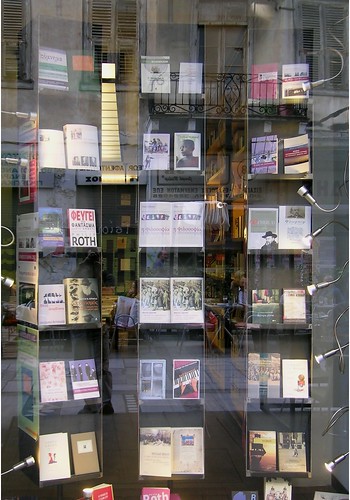
Two. The bookstore about to close is Morningside Books somewhere on Broadway and 135th (or 136th, or 137th). I have only spent two months in New York but it so happened I was living a few blocks from that place and I vividly remember spending quite sometime browsing its the old, rusty shelves. I also remember its timid, humble window, which looked nothing like the picture above, taken from a fancy Athenian book store, with more books on the display than on the shelves. Come to think of it, Morningside Books must have been the only bookstore I entered while in NYC, probably intimidated by the size of the crowds in all the huge Barnes and Nobles. As I recalled, the boxes filled with old, used Virginia Woolfs and William Faulkners I was deeply saddened to hear the place is closing down.

Three. Spanish verbosity vs Anglosaxon strictness of content. Having lived in a place where I had to use these two languages interchangeably for more than three years I can see what Molina means. But I cannot help but think how overwhelmed he would be if he were to compare them to Greek. Being in that position (even though not at the level of an established academic like the one he is) I can testify Greek to be superior in bullshitting potential to all existing idioms. The wealth of terms, ambiguities, verbal and written forms is beyond any comparison.

In fact it is so overwhelming that I suddenly realize I am not doing well in not talking (or reading) that much these last weeks. And which also reminds me I have to stop writing and go on to make some long-promised phone calls to friends that have not heard me talking for ages.

(...not that they are missing anything...)

Wednesday, November 25, 2009

the greatest book ever written


"I begin to long for some little language such as lovers use, broken words, inarticulate words, like the shuffling of feet on the pavement".

There are still things to appreciate while in the army, in fact one thing only and this is -I 've said before- time. Time to undertake tasks that would otherwise result too demanding for one's usual 24-hour day. The army provides you with countless hours of idleness, which in turn offer the opportunity for some serious reading. A lot of reading.

Thus, I have grasped this opportunity to delve into a number of unread pieces of my bookshelf, especially the most fearsome ones, those that remained obstinate on the upper shelves resisting me, mocking me for my lack of time and/or daring to bring them down and wonder through their pages. Since there's not much that is really demanding while in the army, this is how I ended up finishing the "Magic Mountain", "Rayuela" and "Light in August" while serving my country at the same time.

The last in this series of great books though, requires a special mention. And this is because it is probably the greatest book ever written. The Waves, by Virginia Woolf.

I know such an aphorism may sound odd to many, especially coming from someone who's not an expert in literature. There is however something so haunting in this book, something unstructured, diffuse and yet profound that urges me to call it thus. Because there are books that give you pleasure, there are the ones that make you want to read more and the ones that make you want to become a writer. And then there comes a book that makes you realise, the one that conveys at the same time the sadness of everything that is worth having been written already and the enormous joy of allowing you to discover it anew.

"The Waves" is not a great story. But it is at the same the greatest of all stories, the story of everybody's life. It is more of a poem than a novel and less of a poem than a play. It transverses all norms and crosses literary barriers that weren't even existent at the time it was written. Most importantly, it resolves the eternal question between content and form with a sublime indifference. In the "Waves", form IS the content. The book's internal rhythm is what matters most. The marginal plot develops at the background forming the bed to the characters' stream of conscience. But it the characters conscience, their thoughts and pondering, their doubts and certainties that makes one feel he is doing something more than reading this book. He is living it.
Above all, the book's greatest achievement, what makes it so inexplicably important is the fact that each phrase belongs to that special powerful kind, the one I have discussed before here. Each phrase in this book gives the impression that it is exactly what needed to have been said.

And I cannot escape admitting that this book is what I needed to have written.

Friday, February 13, 2009

thus spoke the man in the street


"What a curse living in a world so damnably orphic, where there is no room for the language of the man in the street. In a world where the man in the street cannot speak, even the poet has to remain silent"

Umberto Eco
On Symbolism


I recently read "On Literature" by Umberto Eco (on loan from Valentina), an interesting collection of essays on literature and literary criticism. Although some of them were probably a bit advanced for my literary background, I found most of them quite entertaining and with stimulating aphorisms like the one I am posting above. Apart from its certain appeal to my political views (not to mention my disdain to any kind of elitism) it reminded me of the nicest anecdote I can remember regarding art and its appreciation. I post it below the way I remember it, probably a bit embellished by the passing of time since the first time I heard it narrated by a very good friend.

Here it goes:

Three renowned film directors were once interviewed on a popular radio show. The show host started by asking the first one -known to be a passionate realist- what in his opinion was the purpose of art.

He said: Imagine an everyday scene in a very common place, a small street of a middle-sized city. Now imagine a common man, let's make him a builder or a docker. We give him an imaginary line in the film. What would this line be? In my opinion, what the man on the street has to say is a simple phrase, something as common and ordinary as his ordinary life. Because in the end, the purpose of art is to imitate life.

The host then turned to the second one, a prominent representative of the romantic wave and asked him the same question.

He said: Art is indeed an imitation of life. But life is not always ordinary. Life can be full of surprises. Utter greatness and extreme misery may sometimes be hidden in the most obscure clefts of everyday routine. Art's function is to reveal the unexpected. To clearly state the possibility for every man to rise above the ordinary. What the man on the street has to say? I say put in his mouth the greatest universal truth, the most outstanding, crucial aphorism. Make his words resonate in the souls of your spectators forever.

The radio host was delighted with this exchange of opinions. It looked like he had touched a very sensitive point and was very excited with the way the conversation was developing. He turned to the third director, one that had never been a particular fun of a given art movement and asked him his view on the matter.

Then he said: It is true, life can be ordinary and life can be exceptional. There are people who lead passionate lives, those that weave the same fabric of history and there is the man on the street who passes his ordinary days entangled in this fabric. Nonetheless there is space for greatness in everyone. Each one of us, our docker father, an illiterate man who works in a factory, an uneducated housewife are all very likely to spend our days without achieving greatness. Still, for each and everyone of us, there will come a day, long after we will be gone that someone who knew us, someone who loved us, someone whom we have hurt, will remember us. He will remember something we did or something we said, something that made an impact in his life. It may be a simple joke put brilliantly in the context of a moment, a proverbial curse, or wonderful words of love, nothing that would sound awkward out of our mouths but still something that touched the other so deeply that he still remembers them. Such are the words that make us immortal, and such words would I look for to put in the mouth of the man on the street.

And that was about when the show was interrupted by the stupid advertising jingle of one of the sponsors.

Tuesday, February 3, 2009

where did all the scientists go?


The following letter is to be published in the upcoming issue of the London Review of Books. It is a brief statement appealing for peace, responsibility and -above all- reason in the conflict between Israel and Palestine. Among the undersigned I spotted musicians, actors, photographers, film directors among a number of prominent writers. I could also recognize the names of at least seven Nobel prize laureates for Literature.

The reader is kindly asked to try and spot at least one person even distantly related to science.

He is also kindly advised to make a useful comparison with this document.

(In the photo: Participants of the 2nd Pugwash Conference on Science and World Affaires, organized in 1958 by Linus Pauling, Nobel Laureate for Chemistry AND Peace)

below the letter addressed to LRB by Daniel Barenboim et al.

The London Review of Books
Volume 56, Number 3 · February 26, 2009
'Please Listen, Before It Is Too Late'
By Daniel Barenboim

To the Editors:

Your readers may be interested in the following statement by Daniel Barenboim and the list of those who have supported it.

For the last forty years, history has proven that the Israeli–Palestinian conflict cannot be settled by force. Every effort, every possible means and resource of imagination and reflection should now be brought into play to find a new way forward. A new initiative which allays fear and suffering, acknowledges the injustice done, and leads to the security of Israelis and Palestinians alike. An initiative which demands of all sides a common responsibility: to ensure equal rights and dignity to both peoples, and to ensure the right of each person to transcend the past and aspire to a future.

Daniel Barenboim

Adonis, Etel Adnan, Alaa el Aswany, Dia Azzawi, Agnès B., Ted Bafaloukos, Russell Banks, Tahar Ben Jelloun, John Berger, Berlin Philharmonic, Bernardo Bertolucci, François Bayle, Idil Biret, Christian Boltanski, Pierre Boulez, Jacques Bouveresse, Alfred Brendel, Peter Brook, Adam Brooks, Carole Bouquet, Daniel Buren, Ellen Burstyn, Huguette Caland, Jean-Claude Casadesus, Carmen Castillo, Patrice Chéreau, William Christie, Paulo Coelho, J.M. Coetzee, Roger Corman, Jean Daniel, Régis Debray, Robert Delpire, Jonathan Demme, Plácido Domingo, Umberto Eco, Elliott Erwitt, Adolfo Pérez Esquivel, Rupert Everett, Michel Faber, Carlo and Inge Feltrinelli, Ralph Fiennes, Filarmonica della Scala, Jodie Foster, Eytan Fox, Fab 5 Freddy, Bella Freud, Martine Franck, Mary Frank, Eduardo Galeano, Jean-Luc Godard, Richard Gere, Gamal Ghitany, Amos Gitai, Edouard Glissant, Jean-Paul Goude, Nadine Gordimer, Günter Grass, Jürgen Habermas, Michael Haneke, Donald Harrison, Milton Hatoum, Sheila Hicks, Bill Irwin, Steven Isserlis, Philippe Jaccottet, Elfriede Jelinek, Samih al-Kassem, Naomi Kawase, Ya¸sar Kemal, Rachid Khalidi, Edouard Al-Kharrat, Michel Khleifi, Gérard D. Khoury, Abbas Kiarostami, Stephen King, William Klein, Abdellatif Laâbi, Jacques Leibowitch, Jemia and J.M.G. Le Clézio, Stéphane Lissner, Radu Lupu, Yo-Yo Ma, Amin Maalouf, Claudio Magris, Issa Makhlouf, Florence Malraux, Henning Mankell, James McBride, John Maybury, Zubin Mehta, Waltraud Meier, Annette Messager, Duane Michaels, Anne-Marie Miéville, Marc Minkowski, Thomas Mitchell, Ariane Mnouchkine, Sarah Moon, Edgar Morin, Jacques Monory, Fernando Morais, Jeanne Moreau, Georges Moustaki, Oscar Niemeyer, Jean Nouvel, Kenzaburo Oe, Orhan Pamuk, Clare Peploe, Michel Piccoli, Maurizio Pollini, Christian de Portzamparc, Simon Rattle, Alain Resnais, Claudia Roden, Arundhati Roy, Moustapha Safouan, Walter Salles, Susan Sarandon, Fazil Say, Elif Şafak, George Semprun, Hanan Al-Shaykh, Pierre Soulages, Wole Soyinka, Ousmane Sow, Staatskapelle Berlin, Salah Stétié, Juliet Stevenson, Meryl Streep, Elia Suleiman, Peter Suschitzky, Tilda Swinton, Sam Szafran, Zeynep Tanbay, Uma Thurman, Desmond Tutu, Shirley and Charlie Watts, Abdo Wazen, Jacques Weber, Wim Wenders, Debra Winger, Daniel Wolff, Neil Young

Saturday, January 31, 2009

the greatest of all ideas


It is perhaps my greatest ambition, if it qualifies as one, to be able at some point to reconcile the worlds of art and science (in that order). It goes without saying that such an ambition is -in my case- to be undertaken at a passive level, that of the receiver and not the one of the transmitter.

On today's El Pais, in a very interesting article , Antonio Muñoz Molina came to encourage this ambition of mine, by comparing Darwin's "Origin of the species" to the works of Dickens and Balzac. It's been a long time since I read the "Origin", mostly out of curiocity than out of literary or scientific interest. Back then I was a young student of chemistry with no particular interest in literature or biology. Therefore, I am not ashamed to admit that I never noticed the special style that Molina is talking about.

Almost a decade has passed since then, I now hold a PhD from a biology department, I have grown more interested in literature and forms of art other than football, I have read a number of books, among them "The voyage of the Beagle", Darwin's log of the most famous journey in the history of science. I still cannot admit being able to perceive what Molina sees in Darwin that reminds him of Flaubert or Verne, or Tolstoy. Nonetheless I agree that the pleasure we get out of a great idea is very similar to the spell cast upon us by a great book.

And in this sense, the austere simplicity of Darwin's greatest idea, its development and final conclusion and the influence it still has today, can only be compared with the finest of prose.