Showing posts with label Journalism. Show all posts

Thursday, November 10, 2011

The "political consensus" as an appeasment


The following post was originally published in Greek, some three weeks ago. It has been -badly- translated and reposted here in English for the sake of some stubborn readers who keep asking for news from Greece. Given that the problematic developed in this note -whether or not a coalition government is beneficial for Greece- was finalized only a few minutes ago, I thought it timely to go on and post it again.

Only yesterday (20/10/2011) , with the events already in place to overtake us, the Prime Minister met with the leader of the opposition and asked him to join him to Brussels for the EU Summit. The call resulted in a fiasco. Shortly afterwards, the known communication jackals rushed to portray it as a failure on behalf Mr. Samaras. Both were expected and do not deserve special mention.
What is a little more important is the whole conversation is about this vaunted "consensus" and especially the commitment to it by both members of the government and a large part of the media. The arguments are pretty much as follows:
1. These are difficult moments and political forces need to show unity. The unity will find its reflection in society, which in great relief will experience the historic reconciliation.
2. Our lenders and the accompanying voracious "markets" will judge this consistency between government and opposition as a sign of political maturity. Their satisfaction will be expressed in addressing our country's lending deals with milder economic conditions.
3. Our democracy will finally pass from the "cavemen stage" of the traditional, monolithic debate of ideologies, to that of modern European parliamentary cooperations.

The strongest evidence of the importance and urgency of consensus is the urgent desire of our European partners, a desire that ultimately did not even bother to disguise itself as an "appeal", instead it was manifested as a "demand". This "demand" alone would suffice to make the above executives and their supporters to think twice before advocating the consensus and a coalition government. For one simple reason: That it is extremely doubtful how a consensus between government and opposition would serve the interests of the country under negotiations with exactly those who are urgently asking for it! Under continuing cruel and relentless-as we are being told-consultation with our lenders, the "much-desired" consensus would not work beneficially but only appeasingly. With all the negative implications. Therefore it should be clear that the above arguments in favor of a consensus are perforated. For the following reasons:

1. This so-called "consensus" will not find its reflection in society, for the simple reason that society as a whole is opposed to the imposed policy regardless of wherefrom it originates. Consensus between the two big -at least until recently- parties will simply increase the public feeling that "they're all the same" and will further undermine the faith of the people in the parliamentary system.
2. Our lenders will find an unprecedented opportunity to harden their attitude in terms of their requirements from the current government, which among others will lose yet another bargaining chip. The moment there will be no alternative policy to counter the terms being debated, these should be already considered as accepted. It's surprising how something so obvious has escaped our government officials who to the contrary keep reminding us of the pressure conditions under which the negotiations with our lenders are being conducted.
3. Whether such a development will be for our parliamentary democracy a sign of maturation or regression is evident. Democracy is based on difference of opinion. To openly say that 80% of our MPs being COERCED to agree on a major issue constitutes a progress of democracy is not only amusing. It is dangerous. It suffices to see which political elements within and outside the parliament (far-right, ultra-neoliberals, major mass media groups) are fearlessly backing the latest idea for a national unity government to understand the stakes we are facing.

To wrap it all up, the "consensus" is neither a solution nor a sign of maturity or a springboard to reconcile the divided nation. Instead it is the tombstone for any confidence in the parliamentary republican system  for a large portion of society. It will be a dangerous diversion from our democracy and the easiest way forward for those who negotiate the conditions of lending our heavily indebted country.

The rush and fervor with which some advertise it makes one wonder. Or maybe not?

Originally published in Greek here

Saturday, May 21, 2011

it's always May

(Young protesters changing the name of the City Hall Square into 15th May Square in Valencia. Photo by: jacobictus)

It's only been three days since I was contemplating on the need to act, indignant for my passive reaction to what is happening in Greece, discouraged by the way the state has decided to use the police against protesters and disgusted with the way the mainstream media seem to back them up. Thanks to the same media, who have the suspicious tendency to discover a new "terrorist" every time our government is about to announce another set of austerity measures, I -and the majority of Greeks- was still ignorant of the massive protests all over Spain until a few days ago. It looked as if the sensitive journalists of the establishment have failed to realize what was, what IS happening in Spain, where people, young people still maintain the courage to take to the streets, march, shout, even camp in Puerta del Sol, Plaza Catalunya and elsewhere without having to face tear-gas cannisters and globs.

Even more, it looks as if in Spain, the media still see the people -especially the young- for what they really are. Unemployed, in search for a low salary and an even lower rent, disappointed with how their education has turned them into by-products of a system of labour that cares more about interest rates than people and infuriated with their leaders that are too stubborn to realize what is obvious to almost everybody except perhaps to some short-sighted bureaucrats in Brussels. That things, as they are, are simply not working.

The movement of May 15th, is a movement of the young, which sparked of in May, in a European capital. The similarities to that other May, the Parisian one of 1968 end here. The French of the 60s were suffocating in a world of post-war prosperity. They were asking for "imagination to assume power", they were clashing against the police and went back to school once their revolution was smashed. The Spaniards (and the Greeks, the Irish, the Portuguese, tomorrow even the French and Italians) of the 2010s are the casualties of economic warfare. They demand a decent job with a decent pay, a decent place to live. They are pacific and non-violent (for now) but once, when, if their revolution is crashed they will have no other place to go than the exact same streets they now occupy.

Just think about that.

Wednesday, May 18, 2011

the crisis and why one should care


It's as simple as that. The more you care about the current economical crisis, the more you get entangled in something that is beyond the grasp of the great majority of the people, even well educated ones. Over the last year, I have been trying to understand the basics of the global financial system through reading of newspapers, analyses, economists' blogs, by watching (good and bad) documentaries and talks on TV. But there was just too many SWAPs, too many derivatives and too many interests (literally speaking) for a poor bioinformatician to handle. I ended up wasting a great amount of my time without really getting a more elaborate idea than the one I had in the beginning: "There is something systematically wrong in this system".

I soon reached the conclusion that one should not really care about it. Let's face it. Life is short and one cannot expect but to pursue only a small part of his dreams over its course, the amount of which will be greatly reduced if he were to spend his time trying to understand how others pursue their own. My dreams have to do with understanding the way nature works, the particularities of the human soul expressed through literature and music, the extent of human ingenuity through football tactics. Other people's dreams have to do with how to become rich at the expense of others. It is a minor dream chosen by petty people. I said, let them have it their way.

The problem is that THEY are not letting me have it MY way.
Over the last week, these petty people, the little men (and women) in Brussels, Strasbourg and whichever place it is that their insignificances choose to hold their meetings, have been trying to "convince" the greek political parties (and hence the Greek citizens) to reach a consensus otherwise they will not carry on with the financial "aid" towards our country. The consensus here being simply the opinion the two greatest parties have on the memorandum that the greek government has signed with the IMF/EU/ECB "troika". It is, in fact, a common extortion of the worst kind. They are not urging the political forces of the country to reach an agreement. They simply demand that they all accept the -already signed- terms of the treaty as being the only way to go. Yes, we are back at the times of "total solutions". "Arbeit machts frei" is soon to follow.

Under these circumstances, carrying on with one's own business simply is not an option anymore. Even if for the majority this looks like no great a change, we are facing a challenge on which we cannot turn our backs. Democracy is at stake, the whole tradition of the Enlightenment, on which our culture has based its foundations is in danger. Lending money in a way that would have made Shylock blush is one thing. Making sure that a pay back will be done in a way that would ask for ever greater loans, thus holding a whole generation as financial hostages is another thing. But to demand that everybody says "Yes, we love the way you are screwing us up" is a whole different one.

Going beyond just the end of democracy, it is the end of reason.

Tuesday, May 3, 2011

becoming Bin Ladin


Bin Ladin's henchmen and followers have repeatedly kidnapped, killed, decapitated westerners, often innocent reporters, whose bodies were never recovered. Through the eyes of fellow westerners, those have been considered, barbaric, intolerable acts of cruelty not abiding by the moral standards of our advanced societies.

After the killing of Usāmah bin Lādin, alongside three other men and a woman, the same westerners were pleased to announce that justice has been done. Unfortunately, this was justice the Bin Ladin-way. Breaking and entering, shooting indiscriminately -as none of the 25 extremely capable U.S. Navy Seals were harmed during the shooting-, kidnapping the body and bearing it in the sea as "finding a country willing to accept the remains of the world's most wanted terrorist would have been difficult."

Now that ʾUsāmah bin Lādin "sleeps with the fishes", there is perhaps a timely question to answer. Is this the kind of example we "westerners" will pass on to "those rogue, backward muslims"? What has become of the western democracies in times when even a not-so-common terrorist suffers the exact same end would advocate for his victims? President Obama who thought that "yes we could", Frau Merkel who found Ladin being dead (correction: killed) to be good news and President Sarkozy who greated a preposterous act of violence as "a major event in the fight against terrorism", should think again.

Perhaps, they are becoming just like Bin Ladin

Wednesday, April 27, 2011

please do not like this post


When I started this blog I (must have) had a number of reasons. Nowadays, I can't quite recall any of them. Surely, if I try hard I may come up with a couple of new ones but something tells me it would be quite pointless. Over these last five years, there has been so much blogging, tweeting and status updating, that it would be hard for anyone not only to keep blogging but even to find valid reasons for doing so.

It has therefore become striking to realize that there are perhaps more bloggers and tweeterers out there than those who actually find the time -or simply bother- to read all the blog posts, interesting articles and "memes" circulating the "blogosphere". At least, I find it extremely difficult and have thus gradually shifted from being a blogger to panting out of breath to catch up with the bulk of interesting stuff piling up in my Google-Reader page. Not that I manage. Most of the times, I find myself utterly distracted, slightly dazed and disorientated in front of a dozen of open tabs, each pointing to a great album review, a nice piece published on TLS, an interesting scientific paper and a couple of reporting stories, all these in various languages (my moderate ability to read in 4 languages only worsens my distraction), none of which I manage to read in its entirety. What do I do then? I simply click on the "share" button of my browser and there it is. My somewhat interesting discovery is posted as a facebook update or a tweet, for other people to finish up what I couldn't. Read the damn thing!

It's not just me I assume. More and more we are turning into a universe of "sharers" of things that very rarely live up to their real meaning. There is simply so much of information out there that it is impossible for one to parse even the slightest portion of it. We end up reading abstracts in an abstract way, browsing through titles infested with "buzz-words", we share, we post, we forward, we like but very rarely read. Instead we create a universe of links, a web upon the web, where texts and hypertexts are connected like mass-less, volume-less dots without content.

And yes, all and all it's just another dot on the web. So please do not "like" this post!

Tuesday, December 14, 2010

Strike Three - (you 're out...)


This has been the third great general strike since last May. Back then, it all seemed dismal already. Today, a mere 7 months and two more strikes later it looks as if there is no going back.

The most recent (but not the last) of a series of austerity bills hit the ministry desks last night with one more deputy of the ruling "socialists" exlcuding himself from the vote. It was the least he could do not to go down in history as one of those who once gave in to the demands of a foreign, not elected authority that asks for the lowest average income in the EU to be cut down by 10% to 40% and in some cases 60%. Which roughly translates to 10%-40% less spending, 10%-40% less holiday, 10%-40% less education, 10%-40% less health. And 10%-40% more profit for those who used to pay those "surpluss" wages of 700 Euros, the bankers, the CEOs and the company owners who will pay ~15% less taxes this year as a reward for having put up with such overwhelming earnings on behalf of the "lazy" workers of this country.

These workers, will now have to pay the price for having lived on the benefit of "development" for so long. Only this "development" meant a shift of the balance to the bottom. After all this "development" and "expansion" one out of five Greeks lives at the edge of poverty. After all this "growth" you have half a million Greeks unable to visit a doctor. And you see people fighting on the streets for who gets to be the first to look for food in the trash can.

But it was growth for some all right. It was growth for the shareholders who saw their taxes being cut down from 40% to 22% on average over the course of the last 20 years. It was development for the banks who could privatize profits and nationalize debts. It was expansion for those who will now buy this country's forests, coal mines, buses and trains for scrap.
In Europe like in the US the model prevails over the facts. As long as there is "growth" and "development" it's business as usual for those who have their appointed prime ministers cutting the deals. The rest can enjoy poverty.


Update: All of the above, better said -in Greek- here

Wednesday, December 8, 2010

the last stand


Of late I have re-newed my devotion to Thanassis Papakonstantinoy mostly due to the interest epxressed by my good friend J. upon listening to a track of Thanassis, which I had casually posted on my facebook page. After giving J. a brief introduction and urging him to listen to "Vrahnos Profitis" (one of my most favourite Greek albums ever) I also found myself unconsciously pressing "repeat" over some of the tracks of the album.

This is how I got to remember "A. Manthos" (the album's fourth track and one with very particular lyrics) and how I came up with the story behind it. The song's lyrics have been adopted from a poem by Christos Bravos, referring to a real incident between Athanasios Manthos, a photographer of the town of Trikala and Thomas Gandaras, an infamous bandit of the region of Thessaly which took place in the 1920s. Gandaras had an extremely bad reputation among the great land-owners of the region for having an extensive record of kidnappings and killings, but as these were limited against the rich and the powerfull, the poor people were largely sympathizing with him. The legend had it that Gandaras became an outlaw in order to avenge the rape of his wife by a squire, thus he and his gang were more often thought of as "Robin-Hood"-like bandits instead of as fierce killers.

But authorities thought (as usually) otherwise and soon the head of Gandaras was put a price on. As the manhunt was closing down on him and his men, he realized that it was not meant for him to last long. Before his last stand, he wanted to strike a last pose. He decided to have his photo taken. One night, he
forgot all precautions and sneaked into the house of Manthos, by then a well-known photographer in the town of Trikala and the nearby villages. Manthos woke up in awe as the ruthless bandit stood before him but was relieved to find out that all the the outlaw wanted was his portraid done. Thus in the middle of the night, Manthos, who was used to photograph weddings and funerals, took a photo of the famous Thomas Gandaras in the living room of his house and in outmost secrecy. The story of this secret meeting is told in the aforementioned poem "A. Manthos" by Christos Bravos, has been made a song by Thanassis Papakonstantinoy and was recently the subject of a beautiful short film by Vassilis Kosmopoulos entitled "The Trikala photographer".

In the days that followed, Manthos met Gandaras in his secret hide-out where he took one more portrait of his (the one you may see here, taken from the blog of Konstantinos Davanelos) as well as a photo of the entire gang. Gandaras finally met his destiny as he was hunted down and killed by militia-men close to Deskati, Grevena on August 5th, 1923. He was decapitated and his head was exposed in the main square of Kalambaka the following day.

Sunday, August 1, 2010

going the wrong way


With lorry drivers all over Greece on strike for a mere three days, the minister of transports ordered them to break their strike, threatening to recall their permits if they did otherwise. Two days after that, and with truck drivers keeping their ground, the Greek government has employed the country's military forces to take their place and thus resume the distribution of goods and fuel throughout the country. As of yesterday army trucks are delivering fuel to airports and gas stations and somehow this is supposed to be restoring "stability" in markets and transportations.

My fellow citizens who are relieved to be filling up their tanks and finding fresh apricots on the shelves of their supermarket, should think twice. They may be heading to the nearest beach on their cars and motorbikes but they are probably missing the fact that this is being done at the cost of workers' rights being stepped on in the most audacious of ways.

This is a government, socialist only by name (like so many, nowadays), that first cuts down salaries and pensions to almost half of the population, then sits and stares at prices going up at record stagflation rates and decides to take action only when it is about further attacking worker's rights according to the dictates of the IMF. The new law -the reason for the lorry drivers being on strike- asks for a change in the status of a so-called "restricted access profession". For more than 35 years, in order to become a lorry driver someone had to pay a lot of money to get a permit that he could later transfer at will and at a price he decided. The government -aka its IMF "dictators"- have now called against this "unjust" system and are attempting a "reformation" (and you have to excuse words within double quotes but they are necessary). The new system will thus "open" the profession by rendering the permits so cheap that they become obsolete. Justice? Well, not quite. What the new law says is that the permit will be almost free to give away as long as someone has set up a "transport company" under which designated drivers will be working on a contract. What the law actually aims at, is opening the way for big food and fuel companies into a new market, safeguarded until yesterday by the lorry driver unions. Because that is exactly what is going to happen. In the past, individuals may have struggled for a permit that, given the organization of the union, guaranteed them a living but there is no chance for a middle or lower-class (if those still exist) guy to be able to start up a company. On the other hand, big companies have their way paved for them by the state. They won't even have to pay for the permits before setting up their own transport branches that will hire the ex drivers who will be unable to work without a contract.
Now does this sound like a "justified" "opening" of the profession to you?
What it really is, is a ruthless attempt to restructure the transportations sector from being limited-profit free-entrepreneurial into an oligopolistic trust with great profit margins for big companies, with the subsequent abasement of the workers.

What is even more striking is the credulity and submission with which the media have supported the government's decisions, first to force the lorry drivers to end their strike and then to bring the soldiers on the streets delivering gasoline as if Greece has suddenly become North Korea. No talk about workers' rights abuse, no talk about dangerous connotations whatsoever.
But the worst part comes when one sees the public opinion dozing off in this media-administered apathy. As the country is experiencing cataclysmic changes in every possible aspect of everyday life, people are actually backing up the government by demanding this strike be over. That is, they are granting officials the right to undermine the future of thirty thousand people, being too short-sighted to see that what happens to the lorry drivers today, will be happening to them tomorrow.

One fifth of the Greek population is living on the verge of poverty. 18% of Greeks will not visit a doctor for not being able to afford it, some 20% have reduced their spending on everyday goods like bread and milk, but in the end what really matters is that the "poor Greeks" get to have a five-day, well-deserved, overpriced summer vacation which is being ruined by them bloody truck drivers. So "bring on the troops", "stop the strike", "put them behind bars" for wanting to maintain their working status. Everything is acceptable as long as people can ride their cars off to a nearby beach.

Well, it's not!

I hope -for the sake of us all- that people start thinking with a clearer mind once the summer is over and sunbathing will no longer be their first and only priority.
Until then and with the lorry drivers holding firm at a brave standstill, it looks like everyone else is going the wrong way.

Saturday, July 31, 2010

life in the afternoon


With summer holiday just about to begin, I now know which book to take with me to the beach. This year, it's going to be "Death in the afternoon" by Ernest Hemingway. Not so much for the fun of it, or for an obvious debt in reading it (probably being Hemingway's most "Spanish" of books) but mostly because this book seems like the ideal way to lightly ponder about a long-lasting debate on the future of Spain's bullfighting tradition.

Were he alive today, Hemingway, a passionate bullfighting "aficionado" ever since -the legend says- witnessing the Fiestas de Pamplona back in 1920, would have suffered a blow facing last Tuesday's Catalan Autonomous Parliament's decision to abolish bullfighting in Catalunya. Given the region's historical background and its constant drive for breaking its bonds with anything that is Spanish, it is hard to see perceive this decision completely decoupled from politics. In fact, it would suffice to look at the distribution of votes on the matter to realize a -not so strange- correlation between an assumed sensitivity for animal rights and political views. In all, it was a heavily divided vote, with representatives of the local nationalist parties being strongly in favour of the abolition act, in contrast to those of the moderate ones who maintain stronger links with the Central Government.

In what concerns animal rights I am not sure how big this step is. In total, the bulls killed in arenas worldwide should not be more than a hundred every year, a number that is far inferior to the pigs slaughtered in the same period in the Catalan province alone to supply its sensitive citizens with a great variety of sausages. The obvious argument that bulls suffer an agonizing death in the bullring, whereas animals slaughtered for their flesh are killed "scientifically" does not make me feel a lot better. A great number of animals are still being horrendously tortured during drug and chemical testing and death is probably agonizing no matter the procedure of extermination being followed. I can understand the shock of a sensitive citizen at the sight of a blood-squirting, animal dying in its prime but one has to agree that there is a clear difference between slicing the throat of a baby lamp before putting it on a spit and leading a raging bull in the arena against a group of men, who have been trained throughout their lives into treating the animal with utter respect.

No matter one's opinion on bullfighting, he has to admit that the whole point of it goes far beyond simply killing the bull. As a long-standing tradition, it goes a long way back to ancient ceremonies with a great deal of symbolism embedded so deeply that has become invisible today to short-sighted modernists who choose to see bullfighting as a display of barbarism but find the running-over of animals on the highways an inescapable side-effect of progress. Yes, bullfighting is a remnant of old times, and yes a "corrida" is a hard sight to which I would think twice before submitting my children, but then again, are all things of old destined to be abolished? and to what extent is a dying bull more offensive as a sight than what one can see on TV?

I cannot say I am 100% pro-bullfighting, although I have enjoyed a couple of "corridas", and I am not the passionate fan Hemingway was, even if I appreciate a well-performed "Veronica" and can distinguish a "pase de pecho" from a "pase de desprecio". In all, I see a great deal of hypocrisy in trying to ban an activity that is has its roots in the veneration of an animal and during which animals are treated with extreme respect if not still considered sacred. Those who have never been in a bullfight, or have never read about them (by "Papa" Hemingway or anyone else) may not be aware of the fact that the bull is treated by the crowd with the same respect and admiration as the "torero", that the bullfighter is to be booed and ashamed if the animal is not killed properly (in a way that it suffers less, that is) and that in some -extreme- cases the bull can be "pardoned" by the fighter if the crowd demands it as a reward for its bravery (see for instance the great Jose Tomas pardoning a bull in Barcelona here).

But in the end, we live in a democracy and the decision of a Parliament is to be respected so there is to be no bullfighting in Catalunya as from January 1st 2012. And so the representatives of the people have decided that upon facing a bull instead of grabbing it by the horns, they might as well jump over it. Or even worse, pretend the bull is simply not there...

Monday, July 26, 2010

It's always the 26th


On July 26th 1953, some 130 men badly trained, poorly armed, wearing second-hand military uniforms, stormed the barracks of La Moncada in Santiago de Cuba at daybreak. As the attack was pushed back by the soldiers of Fulgencio Batista's military regime, a great part of the insurgents died on the spot. Others were executed the morning after and the rest of them were captured in the following days, tortured, trialed for treason and imprisoned for life.
They did not, however, serve for life. For it only took five years and 158 days for the man who had led them against La Moncada to finally triumph in kicking Batista and Co. out of Cuba. Fidel Castro's first official decree ordered their liberation and the declaration of July 26th as a national holiday.

Last week, that same man, Fidel Castro, having outlived nine U.S. presidents, several CIA-orchestrated attacks against the state of Cuba and himself, made an official appearance after being considered seriously ill (at some times even at the verge of death) for more than a year. He looked feeble but in good humour and even had time to talk to the people for a couple of hours, for remaining silent has never been his thing ever since he defended his own self in the trials of La Moncada movement.

Castro will turn 84 next month but will still be at the center of attention of the whole country for today's celebrations of the National Holiday commemorating the attack on La Moncada. Fifty seven years after that first attempt to change the lives of the Cuban People, he is something more than a talisman of the state he rescued from the gangsters and the pimps. He is still active, taking decisions, forming policies and even committing errors, something Bill Clinton (to name only one) can only match with explaining the way he led the World Economy to ruins to University students all over the planet. (His fee for such "inspired" talks amounts in the thousands, they say, but maybe he plays the sax for free on intermission).

In the meantime, Castro, once the pole of an "axis of evil", demonized for trying to impose a "failed economical system" on the poor Cubans, is seeing how his country sails through the latest international economic crisis, the third one since he took over. I guess he must be entertained with the way his fellows in the US and Europe are cutting down salaries and pensions, watching unemployment rise and public spending decrease. I also guess that by now, having been harshly criticized for nationalizing banks and companies, he must be entertained with how European Governments are using taxpayers money to rescue private banks.
I 'm also guessing Castro, having been repeatedly accused for his insistence on not liberating political prisoners, will be laughing at the new laws in Europe and elsewhere forcing women not to wear burkha, forcing everybody to carry new, biometric passports, registering mobile phones, allowing landlines to be tapped "under special circumstances" e.t.c.

And I 'm guessing Castro will be having the time of his life today. Seeing Cuba maintaining its dignity in times that even sovereign states are being bullied by the IMF and some arbitrary world-dictators named G20. Seeing that Cuba -in the way he has defended it against the wishes of "liberals" worldwide- has not had the luck of Haiti or Bolivia, thus it cannot be devastated by natural catastrophes like earthquakes or un-natural ones like Lehman Brothers.

For Castro, it may not "always be the 26th" (as Omara Portuondo sings in this beautiful anthem) but in the end it looks like history may absolve him after all.

Thursday, July 15, 2010

in the end it's all about football


Last month was a month of traveling, work, reading and partying but first and foremost it was a month of football. Hard as I tried to explain to my girlfriend that the World Cup -apart from being the WORLD CUP- belongs to that special category of rare events -once every four years- that further adds to their immense importance, she still found my enthusiasm (which of course she could only qualify as obsession) increasingly irritating. Having been in a rather good mood (as it always happens while the World Cup approaches the last-16) the time seemed right for me to confront Demetra with the standard, traditional argumentation for the love of the game and the impact of the World Cup

I therefore tried to slowly introduce her to the history of the teams, the differences in the style of play that for so long -not so much anymore, but still- have been connected to the temperament of the people, the Brazilian "jogo bonito" against the Bristish "kick and rush" etc. But having had recently read Jonathan Wilson's -outstanding- "Inverting the Pyramid" I soon found myself over-excited, talking about formations and tactics, arguing for the rise of the modern 4-2-3-1 and the -apparent- decline of 4-4-2 and preaching about posession football being a pro-active strategy. As I realized the expressions on Demetra's face were rapidly shifting from slightly indifferent to utterly bored, I decided I had gone too far and I let it go. By that time the play-offs had already started and I decidedly announced I was to watch all games left till the end. I stayed in to watch USA play Ghana. She stayed in with me, partly out of support and partly -I assume- for educational reasons. Perhaps she could understand what it is that makes football so important.

As it usually happens, by the time you reach the semifinals, even women get to be -a little- interested in the action. With Uruguay about to face the Netherlands in the first semifinal we decided to watch the game in the company of friends (girlfriends included). Before kick off, having been repeatedly asked on which side I was on, I resolved -time and again- to foolish comments of the type "I don't mind", "I like them both" etc. But as the game went under way I gradually shifted from a mild sympathizer of the Uruguayans to the most loyal of their fans . So, I cheered with joy when Diego Forlan scored the superb goal depicted in this post's photo and I stood up from my chair to watch the last minutes as Uruguay struggled for an equalizer.
A few days later, Demetra decided it was high time she went out a bit. As she was having drinks downtown, I was at home biting my fingernails watching Uruguay's agonizing efforts for a late equalizer once more, this time against Germany in the 3rd place final. When Forlan (again) hit the crossbar from a free-kick on the last minute I exploded in a outcry of curses about the world being unjust, the order of the universe and the such!

It is in moments like these, that one realizes the power of football.

When simply by watching a game you start to get involved even when at the beginning you appear indifferent. It is as if you have been set up by a friend on a blind date only to find yourself strangely attracted to the other person and un-strangely in love before you even realize it. In the same way you find yourself cheering for the goals of a far-away country or feeling compassion for a guy being sent off even if you've only seen his face for the first time one hour ago. No matter what the tactics are, wether 4-4-2 is to be abandoned or if Spain's tiki-taka is a defensive or an attacking strategy, in the end it's all about football.

And one day, perhaps, women may feel it too.

Monday, May 10, 2010

let it spread*!


* Yield spread: The difference between the quoted rates of return on two different investments, usually of different credit quality.

Greeks learned what the "yield spread" (or simply "spread") is only recently. The Portuguese, the Spaniards and many more are soon to find out themselves. In simple words it represents a rate at which a government may borrow from other financial entities. Low spreads mean a country is trustworthy and thus can sell its bonds easily. High spreads reflect a generalized doubt on the government's ability to pay back, therefore borrowing becomes more difficult. At usury rates, borrowing becomes impossible and the country goes bankrupt.

Over the last few months the yield spread of the 10-year Greek government bond rose from about 2.5% (last November) to a prohibiting 8.5%, right before Greece was forced to submit to the IMF and to a record high of 10.4% last Wednesday while the Greek MPs were discussing the ratification of the IMF memorandum and with the house of Parliament being sieged by an uncontrolled mass of demonstrators.

As the value of the yield spread is said to reflect the fiscal reliability of the state economy, I find it hard to understand the degree to which my country's credibility has improved within the last five days. The spread dropped by 50% within thirty minutes yesterday morning and it lies now only marginally (and suspiciously) below 5%, which equals the rate at which Greece is to borrow from the IMF and the EU. As from yesterday, everything seems like business as usual for the "markets". Yield spreads are dropping, the Greek Stock Market marking a rise of almost 9% on Monday and news throughout the media of mass deception talking about "a reversal of the climate", "a new hope" and "the light at the end of the tunnel".

All over Europe, people stand amazed with the clarity and consistency with which the "markets" are behaving. Two days ago, the EU announced a "rescue plan" of 750 billion Euro thus openly admitting for the first time that a number of states -and not only the lazy Greeks- are at the verge of fiscal collapse. To this grave danger, the thoughtful "markets" immediately responded by reducing interest rates and with stocks rising all over the continent. Well aren't they nice?

Well, in Greece in particular, there are a couple of things that happened in the meanwhile. These were the -unprecedented- signing of a treaty that is granting to an outside independent organization (the IMF) the right to decide on critical matters of the daily life of citizens of a member state. These were the complete abolishment of working rights, these were the reduction of the lowest salaries in the EU with a simultaneous rise in taxation. These were all "necessary", "unavoidable", "inescapable" sacrifices the people had to undergo in order to convince some German Bank to lend them money with less than 5% interest.

There are of course the skeptics. The ones who look at the salary reductions, the "reformation" of work rights, pensions being cut down even for the poorest and see "a tunnel at the end of the tunnel". Those who take to the streets because they fear they will soon be living on them, who try to sack the Parliament before it is completely run down by un-elected "loan sharks", who refuse to pay the bill for a country whose 60% rise in GDP over the last decade has gone anywhere else but in their pockets.

And this is what is happening in Greece today, in Portugal and Spain tomorrow and soon to a country near you.

Thursday, May 6, 2010

this is your future


There is one clear indication that a society is being destabilized and that is the rise of petty crime. This has been no secret in Greece over the last months. Thefts, muggings, break-ins have increased dramatically not only in the metropolitan areas but throughout the country. Anyone who would refuse to connect this to the current financial crisis would be short-sighted. The crisis is here and it is only financial, but in a society that is so geometrically centered around money, it has assumed dimensions beyond control. A financial crisis has become political, social, moral and -alas- intellectual. Seeing how literally every argument can be twisted, distorted and turned on its head, watching the futility of all measures and protests, one cannot but wonder. Is this the end?

Yesterday three people died during a violent outbreak at the margin of massive protests against the passing of an "austerity bill" that the Greek Government feels obliged to put forward to avoid bankruptcy. The Government is right in suggesting harsh measures out of this dead-end. The Government is wrong in putting forward these measures, which are unjust and whose radicalism is limited to the way it will change poor people's lives. The people have every right to be furious against such measures that limit "austerity" to the lower and middle classes and leave the great majority of the privileged untouched. And some intellectuals are right in pointing out that the measures are futile as they will act only in support and maintenance of the current political system of corruption, injustice and impunity.

There is a new demonstration scheduled for this evening at the same time the bill is going to be voted in the parliament. The people are right in wanting to have a memorial service to the three dead workers. But the people will be in the wrong if they let their anger to drive them down to hatred and violence. The people will be in the wrong if they lose the moral advantage they have always had against their corrupted governments. It is not a question of compliance, submitting to external powers or serfdom. It is purely a matter of survival.

People will be in the wrong if they allow their lives to become subject to pessimism, fear and violence. It is true they have been the constant victims of unjust governments but if the time has come to take things into their own hands -and let us hope it has- they must do so in full responsibility. They cannot -should not- let this society crumble down into a chaos of insecurity that will give rise to "Saviours", bringers of "ultimate solutions", "leaders of the people". We have seen this happen in the past, let us not be the ones who will witness its resurrection.

"Invisible hands" can easilly turn into "iron hands". This is the way it has been planned. They think that the passing from the "rule of the markets" into the "rule of everything" will be assumed physically and with the subservience of a man facing a natural disaster. But this can only happen if we let it happen. In our heads. If we stubbornly keep thinking that the "markets" is the 21st centuries equivalent for "nature", that money is something more than a commodity and that the laws of economy lie beyond and above those of physics.

This is the "dream" they have for us. This is our nightmare. So, let us do ourselves a favour and wake up.

Saturday, February 27, 2010

lost for words...in general


It's been quite a while since I last woke up just to have coffee and read the newspapers on the web, listening to "Ella and Louis", enjoying this blessed slowness on the advantages of which I have commented long ago. This can be seen from the density (not to mention quality) of the posts of this blog. As it often happens, the less you read, the less you are able to write. In fact, sometimes even speaking may deteriorate once you are kept away from books for long. This is more or less my case, for various reasons.

One. I am to travel to Crete once every week, where I have to either talk ceaselessly while lecturing undergraduates on Computational Biology and Programming, or bust my eyeballs in front of my tiny net-book screen while preparing the next lecture.
Two. Because of this work-travelling overload I have barely managed to read one book since the beginning of the year. A saddening output especially when compared to my prolific reading during my term in the army (which I still do not miss at all by the way). Two more books that I 've started reading through February, are still disgracefully lying on my small bed-table. Last but not least, I cannot remember the last time I entered a bookstore.
Three. Partly from guilt and partly from bad organization of leisure time, I have stopped reading on the web. That is no more newspapers, google-reader, daily news updates in four languages. All this is gone. My old colleagues will understand how big a change this is.

So, in one of this wonderfully ironic coincidences, I sat on my couch this morning to read my favourite Babelia on the web (by far the best thing being printed weekly in the Spanish language) where I came upon this article by columnist-writer Antonio Munoz Molina. Ironic, because this article somehow dealt with all of the above. Books, bookstores, talking and writing. I apologise to the non-spanish speakers unable to read this wonderful piece, for not providing a concise summary, but the truth is that it is not that easy to sum up all of the things that come through it.

The article starts with a quote by Hemingway and goes on to mention the closing of a certain bookstore in New York, then goes through a brief history of american literature of the 20th century and ends with a comparison of english and spanish in terms of verbosity, conciseness and wealth of vocabulary. All subjects I was connected to, one way or another.

One. Hemingway's mentioned quote was: "Each writer should have a built-in bullshitting detector". To which point I can already see the smiles on my ex-colleagues' faces. You see, during my term in Barcelona I have become famous for two things and these were: 1. bullshitting while talking (scientific talks included) and 2. bullshitting while writing (this blog included). Funnily enough, bullshitting got me through then and there and gets me through still through every class I have to teach. It's more of a style than an attitude and dear old Ernest can say whatever he wants.

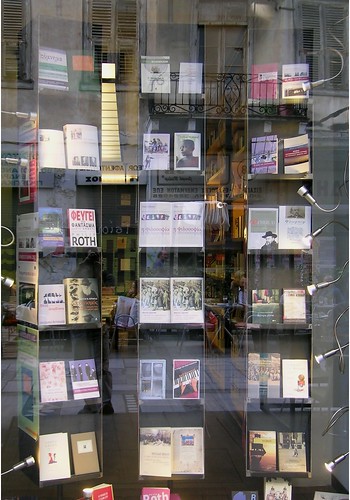
Two. The bookstore about to close is Morningside Books somewhere on Broadway and 135th (or 136th, or 137th). I have only spent two months in New York but it so happened I was living a few blocks from that place and I vividly remember spending quite sometime browsing its the old, rusty shelves. I also remember its timid, humble window, which looked nothing like the picture above, taken from a fancy Athenian book store, with more books on the display than on the shelves. Come to think of it, Morningside Books must have been the only bookstore I entered while in NYC, probably intimidated by the size of the crowds in all the huge Barnes and Nobles. As I recalled, the boxes filled with old, used Virginia Woolfs and William Faulkners I was deeply saddened to hear the place is closing down.

Three. Spanish verbosity vs Anglosaxon strictness of content. Having lived in a place where I had to use these two languages interchangeably for more than three years I can see what Molina means. But I cannot help but think how overwhelmed he would be if he were to compare them to Greek. Being in that position (even though not at the level of an established academic like the one he is) I can testify Greek to be superior in bullshitting potential to all existing idioms. The wealth of terms, ambiguities, verbal and written forms is beyond any comparison.

In fact it is so overwhelming that I suddenly realize I am not doing well in not talking (or reading) that much these last weeks. And which also reminds me I have to stop writing and go on to make some long-promised phone calls to friends that have not heard me talking for ages.

(...not that they are missing anything...)

Friday, October 2, 2009

busy as a bee


Yes, work -or to put it nicer a great number of activities- is the reason behind the lack of posts. My coming back to Athens is going to be official soon (yeaaaah) and some things need to be taken care of. People also need to be taken care of, and good care that is. So they have been my priority over the last week and I intend to make it -the taking care of them, I mean- even more regular as soon as I am stationed back at my old spot: 401 Athens General Military Hospital.

In the meantime, the pre-election fever has forced me to be reading two papers a day (hard work), catching up with the news and giving a lot of thought into finally deciding what to vote next Sunday. (It's not a real dilemma, I am just considering a slight variation from my previous choices).

Getting back to everyday life in Athens, which means everyday life in Greece with all that comes with it has forced me (yes "forced" is the right term here) to start another, lighter blog of almost entirely greek content (and therefore of entirely greek posting and commentary). Greek readers are to be greatly discouraged from checking it out at
http://koympariomaxoi.blogspot.com
as they are bound to discredit everything they thought they knew about me.

Still I have to say that the aforementioned blog is one more reason for the lack of posts in this one, although I promise to try to keep up both at an equal pace.

Monday, May 26, 2008

A la recherche du temps perdu


Yesterday I came upon this beautiful article by Marianna Tziatzi in the Sunday edition of Kathimerini. For the unlucky who -due to the inherent complexity, peculiarity and sublime perfection of the greek language- cannot read it, I can only tell you that it talks about the extreme stress of Greek high-school students facing their final exams that can -under conditions of success of course- lead them to the university. And an interesting phenomenon, which might be as complex and uniquely Greek as our language.

It seems like that upon reaching the end of the school year, with spring -the greek spring, which is something like Germany's hot summer- blooming all around them, the students decide to ditch the last days of classes having saved this right throughout the year by attending every single one until late April. Then, as May kicks in and with the finals only a few weeks away, the classes suddenly empty. It would seem natural and upon a first thought it even reminded me of my school years when I simply could not resist taking off for some beach instead of suffering byzantine history or 20th century literature. But there is a catch here, since these poor fellas head for no beach or park, or bar. They simply stay at home studying their arses off! Thinking that they can make a wiser use of their precious time, they spend fifteen(or more)-hour days on their desks, with the blinds shutting out the buzzing of spring and with some neon lamp dimming the bright sunlight of May.

I was startled.

I have always been considered a good student, and yes not exactly the most hard-working one but in no case could I be described as a slacker. I made it to the University having survived this last year in high school as most of my friends of that generation did. And I made it by what I thought was reaching the limit of my strength and stamina. Reading this article made me realize that if I were to be trying now, I would be probably doomed to failure. You see I don't remember being careful not to miss classes so that I can ditch them towards the end of the year. Throughout the whole season I kept going to football practice (and probably reached the peak of my rather mediocre footballistic abilities exactly on that year). I also remember that it was the same year I learned how to play pool, not to mention setting my personal record for attendance of games of Panathinaikos (back in 1995 when we secured the league with a record of 25 straight games unbeaten, those were the days!!!). I may be digressing -and admitting I am getting a bit old- but the point is this. I don't feel I missed much during my final exams year and cannot but feel pity -pity and respect- for this youngsters who choose to skip the springtime of their seventeens only to devote themselves to algebra and ancient greek. It is beyond me.

There is one thing I can hope for them though. I hope they get to make it to the University only to realize all the things they miss now, will still be waiting for them. And perhaps a lot more. You see it may sound almost paradoxical, but the more you study, the more things you miss even when it comes to knowledge. I still remember my high school Greek Literature teacher of that last year. I hope she's well wherever she is, but I can only recall the most profound sense of disgust for both her and her class. I was just 17, interested in getting to study chemistry, getting to win the football school league and getting laid (the last two probably being connected). In any case, I could not care less about Greek poets of the post-war era and so I remember I came to achieve the lowest mark ever -in a 12 year school career- at the final exam (which by the way did not count for the University scores) when I was asked to comment on Kostis Palamas' "Twelve lays of the Gypsy". I scored a disgraceful 3/20 for filling a single page with scorn and mockery about literature and poetry in general.

And I then I went to the University. Only to realize, that the things I have been missing were still right there on the side of what I thought important and that they were probably even more important. At the side of quantum chemistry I started reading literature (you have to trust me I never read anything apart from Jules Verne and some Hemingway books before I was 18) and next to the pile of biochemistry notes I kept books about fascinating Byzantine emperors. Some five years after that legendary 3/20 in literature, already a graduate, while strolling down Panepistimiou Avenue in Athens I happened to glimpse on the bench of a street bookseller a copy of the "Twelve lays of the Gyspsy" by Kostis Palamas. I bought it for a mere 3 euros. Needless to say, I loved it.

Over the next two days (or I should better say nights, since by the time I was busy studying journalism) I completely devoured it, reading parts over and over again, learning passages of it by heart, reading about it on the web and thinking about subtle references spread around the text. Then, having suddenly realized that I was doing on my own, during my precious spare time, what my disgusting teacher had asked me to do for my final exam five years before, I felt I must have been the stupidest person to have ever lived. At the same time I felt I was delivered from some kind of spell that kept me in darkness for so many years. I felt I was finally making amends for the time lost.

And this is my only hope for these poor kids that spent sunny week-ends over their boring books. I can only hope that the spell cast upon them, gets lifted as soon as possible. And that the time that is being stolen from them is not lost forever.


PS. The photo of this post (an excellent representation of the lost happiness of childhood) was taken by Anaïs Bardet and was kindly provided -upon request- by Sarah Bonnin.

Wednesday, January 23, 2008

where does the money go? (when the markets go low)


A general feeling of optimism in today's news, as the Stock Markets are going up again after the so-called "black" last Monday. And after the panic that got into me the day before yesterday, I am starting to feel calmer once more. The stocks are going up, what a relief!

I have been around only for the last thirty years, conscious of news over the last 20 or something and I still never had bothered enough about what people call "the economy" and how this may be related to the stock markets, or simply, the "markets". Even so, I find it somehow frustrating that we should actually care about what happens in the stock exchange department. I mean, why should I care? Over the last decade I have seen the Greek Stock Market (to give a rather mediocre but interesting example) to grow three times as big within 10 months (that was back in 2000) and then shrink back to the levels of before within the following year. I can assure you that my life did not change a single tiny bit and during those two years, when -supposedly- the "economy" grew to an "unprecedented high" only to reach a peak and crumble down to "depression", I kept earning the same, living with my parents, trying to avoid taking a cab back home, going to the movies every now and then. And yes, the prices of almost everything were the same throughout this period.

So, what is this deal with the "markets"? Why should I be glad if the stocks are up and get depressed when they go down? What's in it for me?

During last Monday, I am told, the European stock markets lost more than 300 billion Euros, an amount that equals the annual gross domestic product of Greece. Where did this money go? Where does the money go, when the stocks go low? More interestingly, I can remember a day or two, when judging from the gains all over the world, the Stock Markets MUST have gained the annual GDP of Greece. Where did THAT money go? Well, you should take my word if I tell you I did not see a penny of it.

I said before, I am no expert. I am a simple chemist, having read my share of Herakleitos and Lavoisier plus a little bit of Marx, perhaps a bit too much of Kondratiev, and thus having inherent difficulties in dealing with commodities that simply appear out of nothing or disappear into nothing. I am probably too ignorant when it comes to how "economy" works or perhaps even stupid when it comes to how it really works. And I may be a bit naive in asking if the losers of Monday can be the winners of today, since we are most ardently ascertained that the stocks ARE going UP as we speak. I guess -and this is as far as my poor economy-related argumentation can reach- that they are probably not the same. That the ones who suffered "Black Monday" were simply outranked by the ones celebrating "White Wednesday", that it is all just a game between players, having nothing to do with normal people lives, and that in any case...

I STILL DON'T CARE!

Tuesday, December 4, 2007

life postponed


This is Eric Hobsbawm, one of the world's most important (caution! not "leading", I hate this term) living historians. He is also one of the few people that I classify as "idols", or -more moderately- role models. I started reading his books at that golden age, when at the end of your college years, you realize there are things that matter much more than daily repeating the same electrophoresis assay at the biochemistry lab. Over the last decade I have read most of his main works, including his autobiography, without stopping being surprised by the insight, with which he reflects on most of the modern issues. A guy who is 91.

And who was here in Barcelona, less than a month ago, when this photo was taken for the purposes of an interview in Vanguardia. By that time I was too busy running control tests on some microarray data and meeting with journal editors. By the time the interview was published last Sunday, I was reading about html code and web servers. And by the time I decided to write about this on the blog, yesterday, I was revising a manuscript to be submitted -hopefully- next week. It seems that lately life has been being postponed and everyday has slightly shifted out of phase.

As I rolled down the Port Vell, coming back from the lab once more after 9pm I listened to Nick Drake getting right to the point "When the light of the city falls, you climb on the city walls".

Only there is no wall to climb on and over this, past the place where trivial working issues keep distracting you from opportunities to meet your idols, or read the books that are piling up on your desk, or watch the films you have lined up only to never make it to the cinema on time...

At least there are mp3 players that keep working on the background of all that and headphones that allow you to bear it in the company of your favourite sounds. But you just wish a new invention would come up that would put work in the background just for once (or maybe twice).

Tuesday, October 30, 2007

Found myself in France...lost in translation

A last minute trip that turned out to be a great experience. It all started when Roderic (my rather easy-going boss) asked me to replace another colleague (Tyler) in a meeting to be held in Lyon. And he did it on such a short notice that even I (the ever-organized-travel-freak) had no time not even to check the exact address of my hotel.

I arrived in Lyon after an 8 hour train journey, only to realize that I had crossed multiple borders in space and time. Because apart from being in France and not in Catalunya anymore, I also found myself in the middle of the winter instead of the mild Barcelonian autumn. Still, adoring the view from the hill of La Fourviere was totally worth it.

What is the main reason for this post though is not Lyon, its two beautiful hills, its two marvelous rivers and the extra-heave local food specialties (try getting the full menu in a typical "bouchon lyonnais" and then sleeping...). Apart from admiring all that, I had a lot of time to spend with francophone people, practicing my otherwise poor french and realizing the beauty that lies hidden not in the differences of idioms but in the profound depths of our universal language itself. Meaning this ability for superposing multiple layers of meaning on an apparently simple structure.

It was on the train to Lyon from Montpellier while browsing last week's Courrier International, when I read this incredibly surrealistic piece of news. The Brazilian Minister of Interior Affaires had just banned the use of the gerund among the civil servants of the state! Clerks, secretaries and even directors were no more allowed to use everyday phrases like "I am working on it", or "we are looking into your problem" so that they do not give the false impression of escaping work by pretending to be doing it! It came as the first clue. Words have a meaning and the language is meaning.

But then, as I kept browsing a bit more, I came across an article about my hometown, Athens and one of its greatest problems, pollution. It was then, in the french translation of a greek article that the sound of my own mother tongue struck me. The Athenian smog, with all its carbon monoxide and ozon was left un-translated and referred to in its original greek term "νέφος" (in the text "nefos"). Suddenly I felt like the article was no more talking about the common smog, a polluting-meteorological phenomenon, but rather about a mythological monster attempting to devour a city cursed by its ancient god-protectors. It is in such cases that language apart from meaning something obvious, is at the same time inflicting a feeling.

Two days later, while spending my time at a bookstore in the center of Lyon, waiting for dinner, I bought "Feux", a collection of short stories and poems by my favourite Marguerite Yourcenar. Since it was still early I started reading it a bit but stopped only at the first phrase. "Je veux que ce livre ne soit jamais lu" (I want this book to be never read). This contradiction, so straight-forward and naive that sounds almost childish reminded me of the opposite declaration, once stated by Borges, according fact that he chose never to write a big novel because he thought the worlds is more in need of readers than writers. I sat back seeping my espresso and could not help but smile at the way the masters of verse use the language beyond both meanings and impositions, achieving an even higher meta-level, whose main inhabitants are ironies, metaphors, allusions and references.

And then I thought that compared to understanding all this, french should be a piece of cake.