Showing posts with label Science today. Show all posts

Friday, December 3, 2010

Wish you were here (E.T.)

That I am a devoted fan of Pink Floyd is no mystery to the readership of this blog (all three of you). I have repeatedly mentioned names and places related to the greatest band of them all in various past posts, including a (personal) obituary for the late Rick Wright. Having a particular strange tendency for both visual and audial connections it was then very easy for me to spot the missing link behind NASA's Astrobiology lab latest discovery.

According to this, the first living organism to be able to incorporate arsenic instead of phosphorus in its genetic material, was recently isolated in lake Mono in Southern California. The bacterion, whose name (GFAJ-1) comes as yet another proof that people in NASA may provide a whole new level to the definition of dullness, was the object of a greatly anticipated press conference which circulated media feeds and e-mail boxes all over the globe yesterday. People who were let down by the fact that the press release (initially making explicite mention to "the search for evidence of extraterrestrial life") turned out to be about an insignificant bug with an utterly boring name should think twice.

A long time before NASA turned to Lake Mono in desperate search for extra-terrestrial life, Pink Floyd had used its surroundings in a famous photo by Storm Thorgerson which appeared at the back cover of their "Wish you were here" album. This is the snapshot of a diver immersing in the alkaline, toxic but calm and ripless waters of Lake Mono. (And judging from the concentration of arsenic in these waters, I can only hope that the photo is the outcome of some artistic superposition of images.)

Whether the existence of extra terrestrial life was something that concerned Pink Floyd at the time, or whether it was the unwordly atmosphere of the environment that matched their nostalgic title of the album, I dare not speculate. However, the inconcistency with which the scientists announce a talk about alien life only to provide us with an example of what can only be terrestrial (even though underwater) can only make me think that in their quest for E.T, the guys in NASA maybe constantly thinking how they "wish he was here".

Tuesday, November 30, 2010

getting there (or quite)


Hard as I try to downgrade it trough scorn and ridicule, the truth is this: I like my job. For the simple reason that I am too lazy to be doing anything I would not really like. When I think about it, there are more than one reasons for liking what I do the most important of which being that it is the closest it gets to providing me with a sense of being inspired and productive.
Research is a sort of an art for the untalented. You are not really good in something, other than solving problems, yet you experience a certain feeling of fulfillment once you do solve them, no matter how trivial.

Fellow researchers (or for that matter, "researchers" like myself) may assure you that such a feeling arises far too seldom. Still the reward lies exactly on this rarity. In this way it better resembles an "epiphany" that makes it look like a true inspiration. The best part though is that it gives one the impression of having solved a difficult problem in the twinkling of an eye. Because apart from all sorts of metaphysical satisfaction, it provides you with the obvious advantage of having very little to do. Once you 've single-handedly solved the problem over lunchbreak, your work is done. You can spend the rest of your post-doc term in happy hours, holiday and general slacking-off, simply by attending the occasional conference.

But is it really like this? Until recently I thought (hoped?) it was. I still remember an early Saturday afternoon back in my old flat in Barcelona, sometime in April 2006. It now feels like a long time ago and it probably is. I haven't talked to my -at the time- flatmate Maria for over four months and that old flat is now being rented to tourists on a weekly basis. But it was on that distant afternoon, while Maria was testing her patience waiting for me to accompany her to the supermarket, that I had that idea, that brief glimpse through the peephole of truth (or at least something that seemed like it back then). It was that moment when, between getting my coat and checking my e-mails that I got a crystal-clear idea of how to solve the main problem of my qualified as "impossible" post-doc project. As I triumphantly switched off my laptop, I turned and gave Maria my "I 've done it again" smile. I walked out the door, certain that my job was almost done.

Well, it's been four and a half years since then and it looks like the job is still almost done. My initial brilliant idea had since developed into a computer program, whose performance had to be bench marked, compared with similar programs based on similarly brilliant ideas, its results had to undergo thorough experimental verification, the whole thing was put to paper sometime in the summer of 2007, reached the desk of my supervisor the next fall, had to wait there until spring 2008, undergo an unfathomable number of revisions, suffer the usual cycle of submission-revision-rejection-resubmission only to be published in its final form last Tuesday. In all, it looks like it took a bit more than the twinkling of an eye.

In the meantime, I have come, seen, not conquered and left Barcelona, having realized that it takes much, much more than a brilliant idea (let alone one that proves to be not so brilliant after all) to get the job done. In this sense research, profession-wise, becomes much more like any other job. Tedious, time-consuming, a stressful endeavour during which the truly inspiring, productive part is consumed within a moment only to leave the rest of the time to be filled by the boring, the tiring and the "what-the-hell"s. "Getting there" is not as easy as just having a great idea. The road is long and winding just like in any other thing that is worth trying.

In the end, no, I am not going to say that "it's the journey that matters" but I have to admit that one can get wiser on the way. Even if it's just by realizing the value of slowing down, catching a breath and realizing that what we do is not important but that it is important that we do it.

Saturday, June 19, 2010

Barcabios - La vuelta

(Downtown Barcelona as seen from Montjuic. Photo by Julien Lagarde)

So, I am back in Barcelona, as promised. It took me more than fifteen months to fulfill this -seemingly- simple promise. But things are not always what they seem to be and what has been placed between me and Barcelona over these months ended up being as difficult to cope up with as it was to let go.

So it's been one year, three months and two weeks since I took my girl, my suitcases and two backpacks full of memories on a taxi to the El Prat airport. We had had a paella and then coffee in Absinta in the Barceloneta, had said "hasta la proxima" to those friends who stood there till the end and at the door, it looked as if as even "hard" Giuseppe, my flatmate for over three years was about to cry. Then we flew back to Athens on the first day of March and the story changed so suddenly that it would be hard for one to think it's not a different story altogether.

It sounds weird that I get to remember all these details so vividly. But memories are very much like the forgotten souvenirs one brings home from a trip. You only find them once you accidentally hit on the cupboard in which you have been keeping them. In my case the cupboard is a rectangle defined by Montjuic, Gracia, Gottico and Poble Nou. And as it appears I have carelessly left something in every little corner of it, I am delighted that not a single moment passes by without me remembering, names, places and faces. A terrace in the Barceloneta where four people had dinner yesterday was enough of a reason for my being here and my coming back once more.

A couple of days ago, my good friend Kostas, suggested I listened to "Boots of Spanish Leather". As I now realize my "souvenirs" from Barcelona are something more than a pair of boots, I feel like I am at peace. It's certainly more than a pair of boots I will be bringing back home to my beloved as it's more than certain that my cupboard, with its "loyal guardians" will always be here with for me to randomly go about digging for lost, but not forgotten "souvenirs de Barcelona".

Thursday, November 5, 2009

ideas live for more than 101 years

...because there is no substantial difference between the zoologist or the botanist that classifies a recently discovered plant under the name of Elephantopus spicatus Aubl., (a name already provided to him by a system) and an Omaha priest that defines the objective conditions, which will assign the social status of a new member of the clan, by granting him the available name of "old-hoof-of-aged-bison".
In both cases, they know very well what they are doing.

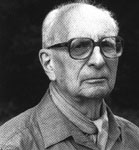
Claude Levi Strauss
La pensee sauvage

Monday, September 7, 2009

ChiosBios #2. Not having a life...


While in the army, I received the -finally- good news of getting a paper published. (Weirdly enough it made it to the cover of a well-respected journal). This would not have happened without the strenuous efforts of my good colleague Hagen and the perseverence of my boss Roderic. This work belongs mostly to them and my name is on it more or less due to an accidentally good idea. (But then again most of the good ideas are purely accidental).

The fact that I choose to post about this -very, very- late publication, to the final acceptance of which I only marginally contributed, can only be highly indicative of the lack of any interest whatsoever in my life, nowadays. Truth be told. Over the last weeks in the barracks I have a reached a point of utter boredom and idleness. Not that I am not doing stuff, quite the contrary. It's just that they mostly consist of activities that could only be described as offending to the the human brain and worst of all they leave absolutely no time for useful thoughts -let alone deeds- that all one can do is to whine about the lack of meaning.

Then again I feel like I am repeating myself over and over and that this post is only here to let me -indirectly- brag about my work (seriously, what has become of me?) and whine -once more- about the army. It's just that, of late people who actually read this blog, (yes there ARE some), were curious about the lack of posts. Not exactly the best way to make them feel I back and active, but still.

Promise to be able to talk about something more interesting next time. After all, football season is on its way.

Tuesday, June 9, 2009

the works and the days

The "Works and the Days" is one of the oldest poems ever written. Its chapters contain a large number of the most popular myths of Greek Mythology. In contrast to his other great work "Theogony", Hesiod chooses the "Works and the Days" to talk about the five ages of men. Therefore the "Works and the Days" deals with the "works" and the "days" of humans, not Gods. It thus states what might now sound perfectly obvious, which is that only humans may undertake "works" and that "days" have meaning only for them, contrary to the eternal Gods who neither have a sense of the passing time and whose existence is self-contained -even if the Greek ones always had a certain tendency for "acts" ( and often rather dubious ones). In this sense, people throughout history have always been meaning to pass their "days" in strong connection with some kind of "work" to leave behind.

In my -humble- case (as this STILL remains a personal blog) my "works" and "days" have been quite disconnected lately. Being in the army is the closest I can think of to being imprisoned, not just because of the obligatory confinement but mostly because of the utter boredom that the repetition of a useless life cycle brings about. In this way one has to face a paradox where on one hand the passing of time is what mostly matters while, on the other hand, the days pass with almost zero production of "work". One has to admit that there is an inherent impossibility for the conduction of any productive, constructive or by any chance meaningful task in the military environment but this only makes the frustration bigger. And which may become even bigger when it is combined with a relative necessity for work, work that cannot be carried out merely because the circumstances do not permit it.

Such were my thoughts last week when I found myself riding the bus back to Arta after a short weekend leave. In front of me lied a bunch of papers containing the comments on one of the papers I had finally managed to submit right before joining the army. And there I was, keeping notes on the margins, replying to some -often suspiciously- mean remarks, thinking over some parts of my work that could be considerably improved, accepting in the end that most of all this was quite useless. I was going back to a place where nothing of what I was thinking could be done, as there are no computers in the army (for the recruits), nor internet access (for the soldiers), or a way to download scientific papers from the web.

In the end I was simply trying to convince myself that my "works" over the last years were important enough to need some more time.
In the end I was deceiving myself with the thought that some "work" of that kind could still be done while in the army.

As I went on turning the pages, listening to Coldplay, I remembered the last time I rode a bus listening to the same album. Some one year ago on the way from Seville to Cadiz, (instead of Athens to Arta), while on holiday (instead of the army), in the company of good friends (instead of on my own), reading a nice book (instead of a paper review). I remembered that back then it seemed that all the "work" could be done in the next few "days", while now it looked like all the "days" I have are not enough, not even for a paper revision.

Most of all, it seemed like the time of the innocence had irrevocably passed by.

Tuesday, February 3, 2009

where did all the scientists go?


The following letter is to be published in the upcoming issue of the London Review of Books. It is a brief statement appealing for peace, responsibility and -above all- reason in the conflict between Israel and Palestine. Among the undersigned I spotted musicians, actors, photographers, film directors among a number of prominent writers. I could also recognize the names of at least seven Nobel prize laureates for Literature.

The reader is kindly asked to try and spot at least one person even distantly related to science.

He is also kindly advised to make a useful comparison with this document.

(In the photo: Participants of the 2nd Pugwash Conference on Science and World Affaires, organized in 1958 by Linus Pauling, Nobel Laureate for Chemistry AND Peace)

below the letter addressed to LRB by Daniel Barenboim et al.

The London Review of Books
Volume 56, Number 3 · February 26, 2009
'Please Listen, Before It Is Too Late'
By Daniel Barenboim

To the Editors:

Your readers may be interested in the following statement by Daniel Barenboim and the list of those who have supported it.

For the last forty years, history has proven that the Israeli–Palestinian conflict cannot be settled by force. Every effort, every possible means and resource of imagination and reflection should now be brought into play to find a new way forward. A new initiative which allays fear and suffering, acknowledges the injustice done, and leads to the security of Israelis and Palestinians alike. An initiative which demands of all sides a common responsibility: to ensure equal rights and dignity to both peoples, and to ensure the right of each person to transcend the past and aspire to a future.

Daniel Barenboim

Adonis, Etel Adnan, Alaa el Aswany, Dia Azzawi, Agnès B., Ted Bafaloukos, Russell Banks, Tahar Ben Jelloun, John Berger, Berlin Philharmonic, Bernardo Bertolucci, François Bayle, Idil Biret, Christian Boltanski, Pierre Boulez, Jacques Bouveresse, Alfred Brendel, Peter Brook, Adam Brooks, Carole Bouquet, Daniel Buren, Ellen Burstyn, Huguette Caland, Jean-Claude Casadesus, Carmen Castillo, Patrice Chéreau, William Christie, Paulo Coelho, J.M. Coetzee, Roger Corman, Jean Daniel, Régis Debray, Robert Delpire, Jonathan Demme, Plácido Domingo, Umberto Eco, Elliott Erwitt, Adolfo Pérez Esquivel, Rupert Everett, Michel Faber, Carlo and Inge Feltrinelli, Ralph Fiennes, Filarmonica della Scala, Jodie Foster, Eytan Fox, Fab 5 Freddy, Bella Freud, Martine Franck, Mary Frank, Eduardo Galeano, Jean-Luc Godard, Richard Gere, Gamal Ghitany, Amos Gitai, Edouard Glissant, Jean-Paul Goude, Nadine Gordimer, Günter Grass, Jürgen Habermas, Michael Haneke, Donald Harrison, Milton Hatoum, Sheila Hicks, Bill Irwin, Steven Isserlis, Philippe Jaccottet, Elfriede Jelinek, Samih al-Kassem, Naomi Kawase, Ya¸sar Kemal, Rachid Khalidi, Edouard Al-Kharrat, Michel Khleifi, Gérard D. Khoury, Abbas Kiarostami, Stephen King, William Klein, Abdellatif Laâbi, Jacques Leibowitch, Jemia and J.M.G. Le Clézio, Stéphane Lissner, Radu Lupu, Yo-Yo Ma, Amin Maalouf, Claudio Magris, Issa Makhlouf, Florence Malraux, Henning Mankell, James McBride, John Maybury, Zubin Mehta, Waltraud Meier, Annette Messager, Duane Michaels, Anne-Marie Miéville, Marc Minkowski, Thomas Mitchell, Ariane Mnouchkine, Sarah Moon, Edgar Morin, Jacques Monory, Fernando Morais, Jeanne Moreau, Georges Moustaki, Oscar Niemeyer, Jean Nouvel, Kenzaburo Oe, Orhan Pamuk, Clare Peploe, Michel Piccoli, Maurizio Pollini, Christian de Portzamparc, Simon Rattle, Alain Resnais, Claudia Roden, Arundhati Roy, Moustapha Safouan, Walter Salles, Susan Sarandon, Fazil Say, Elif Şafak, George Semprun, Hanan Al-Shaykh, Pierre Soulages, Wole Soyinka, Ousmane Sow, Staatskapelle Berlin, Salah Stétié, Juliet Stevenson, Meryl Streep, Elia Suleiman, Peter Suschitzky, Tilda Swinton, Sam Szafran, Zeynep Tanbay, Uma Thurman, Desmond Tutu, Shirley and Charlie Watts, Abdo Wazen, Jacques Weber, Wim Wenders, Debra Winger, Daniel Wolff, Neil Young

Saturday, January 31, 2009

the greatest of all ideas


It is perhaps my greatest ambition, if it qualifies as one, to be able at some point to reconcile the worlds of art and science (in that order). It goes without saying that such an ambition is -in my case- to be undertaken at a passive level, that of the receiver and not the one of the transmitter.

On today's El Pais, in a very interesting article , Antonio Muñoz Molina came to encourage this ambition of mine, by comparing Darwin's "Origin of the species" to the works of Dickens and Balzac. It's been a long time since I read the "Origin", mostly out of curiocity than out of literary or scientific interest. Back then I was a young student of chemistry with no particular interest in literature or biology. Therefore, I am not ashamed to admit that I never noticed the special style that Molina is talking about.

Almost a decade has passed since then, I now hold a PhD from a biology department, I have grown more interested in literature and forms of art other than football, I have read a number of books, among them "The voyage of the Beagle", Darwin's log of the most famous journey in the history of science. I still cannot admit being able to perceive what Molina sees in Darwin that reminds him of Flaubert or Verne, or Tolstoy. Nonetheless I agree that the pleasure we get out of a great idea is very similar to the spell cast upon us by a great book.

And in this sense, the austere simplicity of Darwin's greatest idea, its development and final conclusion and the influence it still has today, can only be compared with the finest of prose.

Tuesday, January 27, 2009

hrönir

or
[On the uncertainty of a past to be invented]

While reading Umberto Eco's "On Literature" (on loan from Valentina) it is impossible not come across a number of references to my beloved Borges, who is after all one (if not the one) of Eco's main influences. I ended up spending half of last Saturday reading Eco's essays in parallel with re-reading some of Borges' finest pieces. And then I reached "Tlön, Uqbar, Orbis Tertius", one of his most important works and my personal favourite.
I am not going to be the first, and certainly not the last to point out the number of ways in which Borges has acted as a "prophet" of modern science (hypertexts, www, reference networks are only a few examples). Nonetheless, there is -to my opinion- something really original in "Tlön, Uqbar, Orbis Tertius". Here Borges describes the conspiracy of some of humankind's greatest minds to create a fictional world whose foundations are based on completely subjective and anti-scientific concepts. The planet "Tlön" is an ultra-platonic universe, whose founding principle is an indisputable, extreme idealism and whose classic culture comprises -according to Borges- "only one discipline: psychology".

The most remarkable of all things "Tlönian" though is the fact that -here comes the best- "centuries and centuries of idealism have not failed to influence reality". Enters the astonishing concept of the "hrönir". These are objects which literally come to existence once someone laboriously tries to imagine them. A guy loses a pencil, starts to look for it persistently imagining where it could be, ends up in finding it on his desk, but we are no longer talking about the pencil he lost. That one is still lying on the bus seat, having fallen out of his pocket. Apart from other aspects (which Borges fails or avoids to mention) the "hrönir" have provided invaluable service to Tlön's archaelogists who are in the position to better interrogate as well as to modify the past, sometime making it as unpredictable as the future.

Leaving Tlön and coming back to the cynical Earth, it appeared to me that there is a striking similarity between the production of the hrönir and the results of my scientific research (or even worse, everybody's scientific research). You see, more and the more often I find myself trying really hard to make something appear, where it once not existed. Data are just too stubborn to corroborate your elegant predictions and hypotheses. As time pressure and lack of money renders the repetition of their natural production (that is the experiments) impossible, they simply need to be re-invented.

But as Tlön only existed once(?) and only(?) in the all-too-powerful borgesian imagination, I find myself unable to produce some convincing, hrönir-like results to support my work. It seems that my way of thinking is either too materialistic (an abominable sin in Tlön) or that I am so unbearably romantic to keep hoping that the day will come, when the numbers will add up, the plots will fall into place and the statistics will need no fine-tuning.

But then again, the inhabitants of Tlön also have a name for the objects that come to existence out of hope. They call them ur.

Tuesday, December 2, 2008

a one-dimensional man


I happened to re-read the "One-dimensional man" by Herbert Marcuse a few months ago. I was hoping to get a better grasp on it being older and -supposedly- more mature than when I first read it during my early university years. But although I did not, I got a pretty good reminder of a number of concepts related to this so disturbing uni-dimensionality, which Marcuse puts at the center of his attention. Most of all, after re-reading the book I regained part of my revolutionary reflexes, which I seemed to have lost after a hectic summer full of useless work. Today, after a full 36 hours of increasing pressure and with a terribly busy rest of the week ahead of me, I realized I am about to lose them again.

I find myself in the rather unpleasant situation to have to produce, interpret and present a significant amount of work in a very short period. The way my boss put it -in a rather stressful way- yesterday night I have "a lot of work and too little time". This stems from a number of things.
One: I am not the finest example of a hard-working scientist. Always too easily distracted, always getting my hands on too many things just because of curiosity, most of the times leaving unfinished business behind me. Well, this business needs to be finished now.
Two: The business to be finished looks quite stubborn to remain unfinished. Numbers don't exactly fall into place but rather need to be "massaged" into it. It's something I am supposed to do, but more and more I find I am quite reluctant to do so.
Three: The business remains unfinished because my bosses thought it could go on forever. Now that they know that I am about to leave soon, they find this to be a comfortable way to put some extra pressure. A pressure not exactly that comfortable to me though.

Still, my laziness and increased sense of inertia notwithstanding, I have put myself to the test. How about getting up earlier and leaving from work later than usual? I can save two more hours of work this way. How about a bit less of reading before going to bed? That would help me wake up earlier. How about skipping climbing on weekends while trying to put some of my results on paper? That will compensate for the fact that nobody feels like writing the papers his name will be on. How about a bit less blogging, a bit less of reading the newspapers, a little less (meaning almost null) of practicing with my trumpet? This way I can run three or four different analyses at the same time, while preparing slides for my upcoming presentations.

Well, guess what! It works!

Now don't get excited, this doesn't mean science is progressing at a fast pace, nor that major breakthroughs are being accomplished. Nonetheless it means that I am being more productive. I program faster, I design the analysis pipelines more efficiently, I optimize my time in such a way that I am getting an unprecedented amount of things done and I manage to put them into slides or on paper in a sort of fashion that resembles a factory's production line. In brief I have convinced myself that I can be what I thought myself completely incapable of. Work like there is nothing else in life. No music other than the one that helps me program (Rage against the machine mostly). No books other than science-related ones. No leisure activities other than the necessary rest to keep me going. Even this post is to be seen as a major distraction but it's just because all my CPUs are working to burning temperature.

At last, after three years of being a post-doc, I have managed to become the one-dimensional man. And you cannot imagine how utterly boring it is.

Friday, November 28, 2008

today

"There remains however a difference even if one takes into account the fact that the scientist never carries on a dialogue with nature pure and simple but rather with a particular relationship between nature and culture definable in terms of his particular period and civilization and the material means at his disposal. He is no more able than the 'bricoleur' to do whatever he wishes when he is presented with a given task. He too has to begin by making a catalogue of a previously determined set consisting of theoretical and practical knowledge, of technical means, which restrict the possible solutions."

Claude Levi-Strauss
La pensee sauvage

Saturday, November 22, 2008

Pessoa's trunk and some useless papers


I mentioned Fernando Pessoa in a previous post and I got bombarded by comments about him and his work. (Most of the comments were communicated orally so don't bother to look for them here, most of my readers are either too shy to write or too direct to come and talk to me in the face).

Then I got into a conversation with one of them about the legendary trunk, where the great inventor of his own antonyms kept most of his work, unpublished until after he died. Apart from the obvious appeal old, wooden trunks may have on everybody, recalling treasures kept in wooden chests, there were connotations -for us "informaticians"- of storage, memory and registries. The mythical literary treasure, which you can actually see in the photo above contained 25,426 items (a precision that our "informatician" reflexes highly appreciated), which have still not been fully catalogued. Parts of this material have been incorporated in the Book of Disquiet, a fragmentary collection of texts Pessoa must have been writing throughout his life, taking notes on envelopes, back sides of old manuscripts or even pieces of carton.

It was then, when I thought of my endless efforts to present my -mediocre- scientific work in an appealing way for a journal editor, all the attempts to start, complete and most of all to wrap-up a scientific paper. For a moment only, I committed the sacrilege to see my incompetence as an analog to Pessoa's shyness or introversion. I imagined a trunk in my bedroom filled with pieces of paper of various sizes, colours and shapes, carrying all the unfinished abstracts I have started to write, the summaries I never managed to expand, the brief reports that never made it to become real papers, last but not least a couple of papers I have actually finished but which I doubt will ever make it to an editor's desk, due to various reasons, not necessarily relevant with the quality of the presented work.

Then I realized, that I should not take it so personally, that probably every scientist on the planet could have his own trunk full of failed or incomplete attempts to communicate his work, to send a message out there, to become heard, noticed and accredited. It is all a matter of exposure in the end, it is the same exposure dreaded by Pessoa, that we are longing for. It is thus inevitable not to fill drawers, hard disc drives or even trunks with all our fruitless endeavours. Only that, contrary to the case of Pessoa, there is the additional fear of becoming obsolete, that is in plain words, forgotten. In fact, the constant fear that drives scientists is the fear of their work being forgotten sooner or later, in the worst case -of the papers that fill trunks and never make it out- being rendered unnecessary, forgotten before it could even be remembered.

It is this fear, which marks greatest difference between works that actually matter -like Pessoa's-, works whose persistence against time and oblivion cannot even be bent by deliberate attempts to withhold and work that doesn't really worth any mention apart form in posts like this one. All we can hope for is that during our wonderfully, joyfully mediocre lifetime we have the luck to produce a couple of papers that would be remembered at least for a while and be worthy to be held in a "cultural arc" like the one of Pessoa, only much, much smaller.

Friday, November 14, 2008

my own personal "third circle of Irrigation"


Some few weeks ago I remember warning my friends about my intentions to switch my working mode into the one of a Greek civil servant. It was to be considered as warning since Greek civil servants are not exactly famous for their commitment and devotion. In my case, however, it had more to do with a sense of a lack of objective and an increasing decline of interest. You see, in my mind, working as a civil servant is less about lack of commitment and more about lack of goals. People think civil servants are not working enough, I think they are simply doing meaningless work. Instead of working for something, they are working for someone. In the end, they have been obliged, or have simply accepted to channel their efforts into something other than what they would like or consider fruitful.

As my main research project was growing to be more and more like the boring job of a ministry clerk and my main focus was shifting from doing something original to re-doing all the things other people have been publishing before I was allowed to, I started to feel like the life of a civil servant would be more suitable for me. I saw myself in a grey office, with piles of papers all around, in a world somewhere between that of Kafka and that of Pessoa. It looked less and less like my sunlit desk at the side of the Mediterranean and more like the one in the photo.

It was then that in order not to get completely depressed, I somehow subconsciously remembered of probably the most famous of all Greek civil servants of all time, Constantin Cavafy. For those unaware of this great man, I can simply recount a couple of biographical facts. He was Greek, living in Alexandria around the turn of the previous century and he was a civil servant for the Ministry of Public works, a position he held throughout his life. There you have it, your Greek civil servant. What makes Cavafy so special, is the fact that at the margin of an extremely boring life, spent between his desk at the "Third cycle of Irrigation" and his rather small, badly decorated, apartment in Rue Lepsius, he wrote a number of poems, whose number was big enough to qualify him as a poet and whose essence and style so supreme as to qualify him the great of them all.

I reflected a bit about this life of his, which most of his friends and acquaintances would describe as rather dull and ordinary, nothing like the tragically, romantic trajectory of Byron, the glorious magnificence of Goethe, or the bohemian voluptuousness of Beaudelaire. I saw Cavafy on his way home, back from work and I imagined him completely detached from the daily routine, drifting away in his timeless universe of interweaving pasts, the Byzantine emperors, the Alexandrian notaries and the forgotten lovers. To him, being a civil servant was simply a condition of subsidy, the irrigation plans, the daily correspondence and the translations were all but the side-effects of a conventional life he was too coward or too wise, (or perhaps both) to renounce.

I imagined how he could safely steer away from all these conventions and slowly, uncompromisingly head towards greatness. Cavafy, was able to achieve immortality. The rest of us, whose aim is the simple deliverance from everyday frustration and the hope for a meaningful life that takes place outside the office and resumes after 5pm, should know that this hope still exists.

And that anyone may be worth his own personal "Third cycle of irrigation".

Wednesday, October 15, 2008

Pierre Menard author of a scientific paper

Pierre Menard is a fictional (?) character invented by Borges in his relatively famous story "Pierre Menard, autor del Quijote". In the story, which is, according to some, an indirect essay on translation, Menard is a French scholar who in the course of his life has devoted most of his efforts NOT to translate, modernize or adapt the most famous novel of all time but to literally RE-write it. That is, not to transcribe it but instead to be able to reproduce it word by word and down to the last punctuation mark.

Menard passed away while still in the process of this unprecedented endeavour, having nonetheless been able to complete chapters 9, 38 and a fragment of 22. After him, nobody has dared to undertake such a monumental work. That is, no fictional character. Because a great number of real people are involved in similar projects. Almost all of them are members of what we call the "scientific community".

The task of RE-writing a scientific paper, as meaningless as it may sound, IS the primary goal of a great deal of scientists nowadays. And apart from its obvious dullness it carries some additional significant difficulties.
First of all, lack of originality. This would not be a great problem if the intellectual activity of RE-search was not -so disturbingly often- preceded by the adjective "original". Over-riding this problem is still considered one of the greatest steps a respected RE-searcher needs to take in his career. And it so happens that once he is over the pseudo-guilt imposed by non-originality he is usually mature enough to be eligible for tenure.
Secondly, RE-writing a paper would imply -in a perfect universe- RE-peating the analyses carried out in the prototype. This constitutes a great waste of time, taxpayers' money and human effort on something that has been done already, but is nonetheless necessary if one is to stick to the rules. On a higher level this tedious activity of RE-petition bifurcates into two options. One is RE-peating the analysis to RE-produce the prototype's results. Let's take a pause here...

This would imply that the results of the prototype are RE-producible. And it may sound ironical but in a world of RE-written papers, results tend to be IR-RE-producible...At least most of the times.

But going back to our bifurcation, the second option provides a more or less simple way around the unpleasant problem of results RE-production. This (not-so-secret) option #2 implies, that one needs simply RE-produce the plots and the tables of the prototype bypassing the upsetting process of actually re-producing the data. This may sound displeasing to many of the inexperienced RE-searchers but I can assure them that it is simply their inexperience which drives them away from the real focus. Which -I dare remind them- is RE-writing a given scientific paper. How this is to be done, is a mere technicality.

Reflection and self-questioning is a grave danger to the exciting project of accurate re-production of knowledge. Once RE-writing the paper stops being the ultimate goal, RE-searchers, especially the young and inexperienced ones already mentioned, may easily follow the dangerous paths of skepticism and doubt, which mathematically lead to innovation, unconventional thinking and sudden impulses to explore unknown problems. It is needless to mention here the dire consequences such practices may have on modern science. Young RE-searchers should be particularly careful on this aspect. Nobody has told them that scientific RE-search is something to be taken lightly and one should be extremely cautious when attempting to RE-state once more, theorems, hypotheses and ideas already put forward thousands of times by hundreds of great pioneers of repetition.

But it is only after he has gone through it all, avoiding the upsets of novelty and ingenuity, that someone really grasps the natural joy that can be felt by the RE-production of originality.

Friday, September 26, 2008

say "welcome" to the machine!


This was yesterday's view of the corridor leading to the lab. The usual, crispy clean, futuristic hallway was blocked by what appeared to be some sort of heavy, important shipment of scientific equipment. In fact it was something much more than just that. It was our own "doomsday machine" or in brief "The Machine"!

For the more observative ones that are also aware of the latest(?) advances in the field of genomics (not that you deserve any merit for that) the inscription on the top left part of the wooden box that reads "Illumina" may say something. For the rest let me just inform you that what we are dealing with here is a third-generation genome sequencer, whose capacities involve ultra-rapid, massive DNA sequencing in short read-fragments, genome mapping and de novo sequence assembly. Oh yes! it also disposes of a bioinformatician-repeller!

Assuming this last (add-on) function, the Solexa-Illumina sequencer will soon start the process of expelling us, the entire Computational Genomics Group, from the fine altitudes of the 4th floor of the Biomedical Research Park of Barcelona, which we currently occupy, to the ground floor of the same building. I can see many of you raising an eyebrow in doubt of the potential of such a machine to kick out an entire department, but things are -as always- slightly more complicated than they seem to be. You see, this doomsday machine, is only the second to be purchased by our Institute and is very likely going to be followed by 6 or 8 more in the process of "our" Centre for Genomic Regulation becoming the "main node" in sequencing in the entire country. (Quotation marks added the way I feel like. It's my blog isn't it?")

I will skip posing the question related to whether spending tax-payers money on trying to become the "main node" is really worth it. I shall also omit questioning the quality of the data these machines are producing. No matter how hard I try over these last six months, they simply fail to make sense (or I am failing to make sense of their profound, unquestionably objective noise). What cannot pass unquestioned though, is something that has fewer things to do with the machines themselves and more with the people (us, the scientific community, or whoever they are) who manage them. Because one of the main side-effects of our dear Institute becoming the "main node" in genomic sequencing all over Spain, would be the displacement of roughly 30 or more "people who treat our data", formerly known as "bioinformaticians", formerly known as "theoretical biologists", (this last term being a remote reference to science therefore abolished some long time ago). In the course of this displacement, we are to pack books, CD, computers, notebooks and the rest to make space for the installation of "the machines", ironically the same machines which will carry on producing the data we will be asked to treat, analyze and (hopefully) interpret.

The bottom line of all of the above would probably be to ask oneself the obvious question: "Since when did people become commodities comparable to technology?".
But I am afraid the even more obvious answer would be: "When did they stop being exactly that?"

I shall leave that question to you, the (few but loyal) readers. What I shall leave to me and to my fellow colleagues is a slightly more existential (thus also more provocative) question. And that is to what extent are we ourselves responsible for such a treatment. I mean, there is a long distance from the "computational biologists" we started out to be, researchers with our own projects and ideas to the "data analyzers", the last part (human but not much less dispensable) in a high-tech pipeline that we have turned ourselves into.

Is it my idea, or are we in the process of losing something more significant than our 4th floor sea view?

Tuesday, September 23, 2008

How should one read a science paper?

Yesterday night, while sitting at my living-room's table, having dinner, a strange thing happened. I read two scientific papers.

This was rather unusual because I cannot quite recall the last time it happened and this is something for which I tend to blame science more than I blame myself.

Still, I read two papers, one by a group of people, whom one of my bosses like to refer to as "competitors" and the other suggested by another of my bosses (I only have two but sometimes I feel they are more). As I was going through the first one, I realized I was facing inherent difficulties in comprehending it. What was really puzzling about it, was that although the title and the brief summary preceding it were describing a clear concept in a quite straightforward manner, the main body of the work was going around the subject in a way that to me appeared rather obscure. I forced myself to go on, putting aside my glass of wine and blaming my recent paper-reading idleness for not being able to grasp simple scientific truths. But the harder I tried, the worse I was getting entangled in its twisted structure. Right when I thought the answer would pop up in the next page I would find myself staring at exotic scientific terms, which I was coming upon for the very first time, funny-sounding acronyms which said nothing to me and all this combined with plots, where I could not make out the real data from the simulated ones.

I reached the end of the paper seriously questioning myself and thinking whether I had become inept for activities of this sort. I gathered all the strength I had left and went on to the second one.

I found myself in front of a similarly clear and straight-forward title, so I thought "not again!" To my relief it was not the case. This one was as clear as its title, the concepts were all well-explained from the start, the necessary "catchy" acronyms had been clarified in the very beginning, the plots were self-explanatory. As I was regaining my self-esteem, my questioning gradually started to direct itself towards the writers instead of the readers. Some papers I thought are good and some bad. And that's that. I took some notes at the margins of both articles, washed the dishes and went to finish my wine on the couch with my book.

To this point I should make clear, that the whole process did not take more than what a normal person needs to finish off a salad, perhaps only a bit more, so I guess we are talking about 20 minutes or so. And I hope you find I am right when I say that one should dedicate no more than 10 minutes to go through a scientific paper. It's not that I am a fast reader but I guess if on average it takes one about 10 days to read "Mrs Dalloway" or "Crime and Punishment", it is imperative that he doesn't devote more than 10 minutes to the average science paper he comes upon. (And in case I realize someone has devoted more than 2 minutes in one of my few papers I will be more than happy). This comparison is not entirely unrelated to the fact that right after fulfilling my nocturnal, scientific duties I found myself on the sofa with an essay by Virginia Woolf entitled "How should one read a book?"

The essay is a good and pleasant read, (I assume especially for those who unlike myself are more than simply familiar with British literature) but it was mostly the main point of it that made me think twice about reading in general, and yes -even- science papers in particular. Woolf's main argument is that when it comes to a book the reader has above all a responsibility. For reading it carefully, for realizing the difficulty of writing in general, for judging it with a sincere kindness and a kind sincerity. Furthermore though, -she concluded- the criticism for which we readers are responsible (and in the case of science, readers coincide with critics although not to an extent that I would dare consider desirable) is mostly to be based on brief impressions, images and thoughts that flow as one reads without having to go into detail. Because this is what really matters.

I am not sure science papers are meant to be read as books. But considering the pleasure I get from reading books while my bosses' "paper recommendations" are piling up on my desk, I think I 'll follow Virginia's advice about it. I mean after all, we are supposed to take an expert opinion before serious undertakings, aren't we?

Tuesday, August 12, 2008

steroids for researchers


Since last Friday, I have been trying to follow the Olympics as much as work and time difference permits me. I do it not so much because I enjoy watching archery or cycling but because the flat is so empty that even TV is a good company and -lets face it- any kind of sport is still better than the usual crap of Spanish TV. Over the last four days, I could not help noticing the ability with which swimmers of any nationality, sex or race have been beating olympic and world records, sometimes by three or more seconds. I cannot but be surprised by these athletes who beat opponents, time and their own selves once or twice a day.

I wonder if I could ever be like them, if I could ever become that good at what I do -or pretend to be doing. I quickly realize that I never will. And right after that, I realize that I would never want to. Competition is not my forte, I never found myself comfortable with struggling to be the best in something and even if sometimes I get merit for stuff I do, I fully realize it is mostly based on considerable luck and some residual talent (which is also part of being lucky). You -and by this I would like to have been talking mostly to my bosses- have to believe me. I honestly don't intend to be the best at what I do. Correction: I don't intend to be good at what I do. And by "intend" I don't mean I would not like to. It's just that I am not the least determined to work for it. I believe in luck and talent. If you have it you should not be needing steroids or effort. I don't have it -as most of the people- and since there are no steroids for researchers any effort to convert me into a high-class scientist would be futile. I therefore have to warn you. Do not count on me. My aspirations were fulfilled upon becoming a mediocre doctor of sciences.

Besides joking now, I would like to be good at many things. I want to be a good friend, perhaps someday a good father, I hope I made it through being a good son and who would not like to be a good lover? (if only!) I would like to be a good laugh on Saturday nights out or a good football fun. Once they asked Borges why he would never take up writing a big novel to which his answer was that the world had enough of good writers but was in dire need of good readers. He therefore preferred to read instead. I would also like to be a good reader. And I think I could be really good at it if only work would let me.

Human nature dictates that we aspire merit, recognition and fame. It is all connected to our honest appreciation of what is really beautiful. I grew up admiring great writers, thinkers, footballers and trumpet players. I grew up a bit more and wrote a couple of stuff that made me feel nice, made thinking a profession that pays the rent, played football for the school team and have fun while blowing a trumpet every now and then. At the side of all that, I did not forget to simply grew up. I simply grew up to accept the fact that Maradona, Wynton Marsalis, Castoriades, Einstein and Borges are to be admired because they are out of reach. Geniouses that lie at the edge of the bell curve that are mediocrities define. And I have grown up to know it's not bad to be mediocre. What is bad is not being at peace with yourself by accepting it.

I was making these thoughts and then Mike Phelps came to break one more world record.

Wednesday, July 2, 2008

Das Schloss

It was back in September 2005, while visiting the lab for the first time. I was in Barcelona for a short stay which included an interview with my current boss(es) when two of my current colleagues kindly offered to take me to lunch. At some point the discussion came to the unusual "structure" of the Institute, which even to the ears of a Greek, accustomed to bureaucracy, sounded quite weird. People belonging to two or more Institutes at the same time, while being paid by a third one, some of the centers affiliated to the state, others simultaneously forming part of a semi-private University, most of them overlapping with each other, being reciprocally part of each other and all of them at the process of being incorporated into the Biomedical Research Park of Barcelona (PRBB, also known as the "Alcatraz of western Mediterranean").
"I am telling you it's Kafka's wet dream". My witty colleague and compatriot Karolos could not have come up with a better description of the situation.

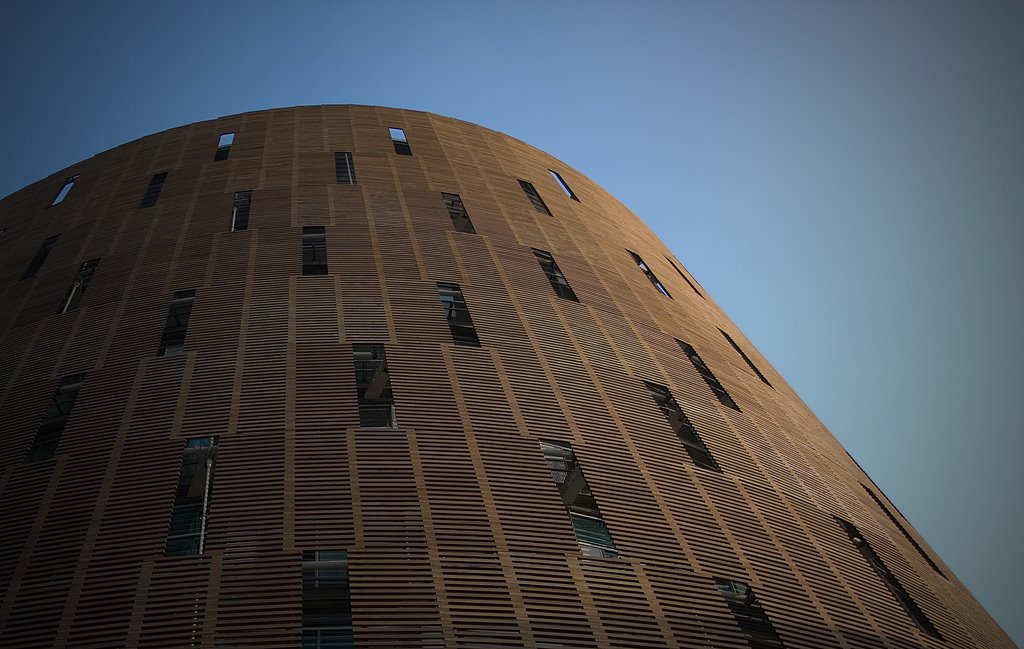
Two and a half years later, I officially belong to the Center for Genomic Regulation (CRG), which is part of the Biomedical Research Park of Barcelona (PRBB), my boss is a group leader in the CRG, also belonging to the Grupo de Reserca en Informatica Biologica (GRIB), which is part of the Instituto Municipal de Informatica Medica (IMIM), while he teaches as a prefossor at the Universitat Pompeu Fabra (UPF). All of the above institutes, groups, entities share the common roof of the building you see in the photo. In this labyrinth of names and entities, it is difficult that someone doesn't remember Karolos' words. PRBB is since last week the closest I can think to Kafka's Tower. "Das Schloss"!

Last week I was expecting a package sent by mail from a musical store in Galicia. As I had to attend a PhD thesis defense (my first as member of the tribunal) I was not at the building when the package arrived. I received a phone-call from one of the Tower's receptionist. As her name was not mentioned we cannot resist the temptation to call her "Barnabas", a strange name for a receptionist but not for a messenger in the "Tower". In fact for someone with so little efficiency and such a big mouth, "Barnabas" falls just a little short of perfect. Anyway, the message of Barnabas was that there was a package for me, Mr N. at the reception of IMIM on the first floor of the Tower. When I asked why the package was at her hands since I belonged to the CRG, Barnabas employed the most stylish of the "towerish" accents to inform me that I was Mr. N. belonging not to the CRG but to the IMIM and that I should therefore look for the package at the mailbox of the GRIB!!!

Mr. N., myself could not but feel puzzled. Like some other Mr in a different tower I thought to be working for someone else than I actually was. Upon arriving to the Tower the same afternoon I went to look for my package at the designated mailbox, as the law-respecting Mr N. I am. Not to my surprise it was not there. Nor was Barnabas. And neither was I surprised when the secretary occupying her spot -we can call her Olga- told me she knew nothing about the package, or who I was, or where I worked at. She advised me to look for the parcel at the GRIB, so I went up to the 4th floor to do so. The package was not there and the secretary of the GRIB -whose name could be Amalia, although it is not- suggested that I looked for the person responsible for purchases at the CRG, -I shall call him Gerstacker-. Although this was not a purchase that the CRG would know anything of, I went up on the 5th and after a brief conversation with Burgel, the CRG receptionist I went to look for Gerstacker. By that time I was getting close. My assistant Jeremiah -she's a girl, but "Jeremiah" IS the proper name for Mr. N's assistant- had joined me in my quest and we managed to talk to Gerstacker together. At the beginning he was reluctant in helping me. It was late in the afternoon and most of his colleagues must have been having beer at the "Herrenhof Inn" already -which could also be called Bitacora but is not, not in this story at least-. The only thing he could tell me is that he would look for it and that I should send a message to Barnabas. As I told him that Barnabas is the messenger and that it would be silly to send a message to the messenger he looked at me with an angry look so me and Jeremiah decided to go. It was late and I had flight to catch.

Needless to say I never found the package myself. It just appeared on my desk two weeks later. When I asked how it got there nobody could tell me. Neither Hans, Frieda, Pepi or the Teacher knew how it got there. I tend to think it was Galater, the one who assigned Jeremiah as my assistant but somehow I would like to think that it was not him. I 'd like to think it was Klamm. The one I am supposed to be working for and never get to meet. The one that everybody claims to know, but cannot really describe.

Standing by my desk, looking at the un-opened parcel, I could not stop thinking about my life in the Tower after 30 months. How a lot of things that sounded so clear when I came here now seemed to be completely out of reach like Klamm, or so complicated like getting a package on your desk.

I remembered another tower I had read about once and a distant relative of mine, a distant relative of all of us. Mr K. Was I to end up like him, working as a janitor instead of the land-surveyor I was once destined to be?

Friday, April 18, 2008

Order out of chaos - A short tale about strange fruits

Once upon a time there was a greengrocer in Barcelona's Boqueria market. He was famous for arranging all the fruits in well-ordered piles like the one shown in the photo. He was a great specialist in strawberries and oranges and was highly estimated among his colleagues. Then, one day one of them, also quite highly esteemed not for his piling of fruits but for their production came to him and proposed him to join in a new enterprise. The producer was planning to go into the grape business and he wanted him to think of a way to pile them up properly. Our greengrocer had never worked with grapes before but he had not become famous for turning down interesting offers so he accepted. He then decided to hire a guy to think for a way to pile up the grapes even before the grapes were delivered. The wannabe "piler" arrived at the market bench full of enthusiasm and started devising a number of ways to pile-up the grapes all neatly and nicely. He made a lot of effort to understand the shape and size of the grapes, read a lot about them in books and ended up with an acceptable piling strategy that could at least work with the grapes he had in mind.

Both the greengrocer and the piler were quite happy, when one day, a guy whose bench was on the other side of the market suddenly appeared with a small number of grapes piled up in what looked to be a nicely-shaped cone. Both our heroes were rather puzzled, because of the fact that the way they had thought about was resembling more a pyramid than a cone. In any case they started thinking about how the two strategies could be combined, when suddenly greengrocers all around started piling up fresh grapes on their benches. The greengrocer was really saddened. Only a short time ago he thought of this strange fruit as a possible prospect which would only moderately expand his customers. Now all his competitors were going into the grape business before him and, even worse, it seemed like everybody wanted grapes. Grapes had become fashionable.

The frustration of the poor piler was even bigger. You see, he had spent a lot of time studying the grapes, he thought he had understood them and now he would see all sorts and kinds of these strange fruits piled-up around him that were nothing like each other. Some would be big enough to look like kiwi, others would come in small beads resembling big berries. Some where bright red like strawberries and other pale-yellow like potatos. When he tried to compare one type with another his frustration increased even more. He realized that some of the merchants, when talking about grapes were only referring to one specific type which would be better piled in the shape of a cone, others would pile their own in cubes and so on...

As time passed by the situation became even worse. The competitor greengrocers were starting to make strange allocations about their grapes, piling them up on top of other fruits, suggesting that grapes were to be piled up with oranges and apples and pears, and as you may have imagined, each one had a different combination in mind. Naturally the greengrocer was more and more anxious and kept asking of his helper to think of even more complex ways to pile up the fruit, while nothing would suggest that there was a good or a bad way to do so. It just seemed like everybody would do their own thing, call it a pile of grapes and not care about each other. The piler had not learned to work like this, and neither the greengrocer. Both of them were coming from a school of greengrocers, were the fruits shape and colour were well defined first and then piled-up accordingly. Thus they were in agreement that they should define the fruit first before the pile.

But the problem was that the more the piler strolled up and down the market, carefully approaching the benches and observing the piles, the more frustrated he would get. It was turning out that some of the competitor greengrocers were using other kind of fruit to support the piles, others would mix more than one type of grapes in the same pile, there were a few that were using two types of piles at the same time and even some that were cheating by taking piles of cherries and calling them grapes.

On top of all that the producer which has made the initial deal with the greengrocer arrived finally with the grapes he had promised in the very beginning. In fact it was his assistant who had come to bring the merchandise as initially arranged. And to the disappointment of both our heroes, the grapes she was carrying were exactly what they feared of. There she was putting in front of them all possible kinds of grapes, small and big, spherical and oval, bright red and yellow and pale-white. She had been working for months in the production of grapes, she new everything that had to do with the production as the piler new almost everything that had to do with their possible organization. And there they were the two of them with a bunch of incoherent, strange fruit that could not be organized in one but in many ways.

As their employers were growing more and more impatient, the grape-piler and the grape-cultivator were quite puzzled, walking up and down the market over and over, trying to think of the solution to their problem which was of dual nature. The cultivator wanted to know which type of the grapes were the right ones, -that is if there were one type-. And the piler wanted to make sure that this type was piled properly. Their thoughts were oscillating back and forth from the most daring hypotheses to the most down to earth compromises. Once they would come to think that there was only one type of grapes and all the rest were fakes, then they would ponder one whether the real grapes were a mixture of all these variations. They could not decide on whether the pile shape was to be one or more than one. And they would come to a real confusion when people would ask them about the other type of surrounding fruit and whether the shape of their piles were to affect the one of the grapes.

All the piler could come down to was that this had become a big mess, that this chaos was not to be put into order.

And I am not very sure but maybe this is the end of the story. Or maybe not.

Monday, March 17, 2008

Scientist's block


I copy from Webster's dictionary:

Writer's block
: a phenomenon involving temporary loss of ability to begin or continue writing, usually due to lack of inspiration or creativity.

carrying on from Wikipedia:

Writer's block
can be closely related to depression and anxiety, two mood disorders that reflect environmentally-caused or spontaneous changes in the brain's frontal lobe. This is in contrast to hypergraphia, more closely linked to mania, in which the changes occur primarily in the temporal lobe.

I do not really know which lobe or other topological entity of my brain to look for, in order to better define my state of mind, one which I would dare to call "scientist's block". I apologise for this somehow poetic definition but it's the closest thing that my tormented frontal, back and side lobes can come up with, having gone through two frenetic working weeks with minimal if not disappointing outcome. If in the last post I was metaphorically "introspecting", looking at the interior patio of the Institute, today I can only look at it like in this photo, extending upwards, too steep to climb, too tiring just to think about going up there, and that is both metaphorically and literally.

Scientist's block has not so much to do with loss of ability to work. All the contrary, in my case at least it appears to be highly correlated with working overtime. During the last tow weeks, I found myself spending far too much time in the lab (including late shifts and Saturdays). In all, it has been a period during which I felt rather active and prone to work but -alas- it appears that the excitement one looks for in science, (this little spark that comes when looking at a long-anticipated plot) is not so easy to achieve. In the end, a load of data fell into place, some scripts were better organized, a few new R functions were perfected but that is not so much of progress and falls far from being qualified as success.

Then came fatigue and an increasing craving to take my iPod and my copy of "Voyage au bout de la nuit" to the Ciutadella park and lay on the grass until it gets dark. And perhaps I should do exactly this. I tend to tell people that working in the lab and thinking are two mutually exclusive activities and although their usual reaction is a smile of consolation, deep inside they know, that like myself, they have had their best -or like myself their less mediocre- ideas exactly when they took some time off work, a small pause to ponder and reflect about a problem of scientific nature. Therefore, having just introduced the term "scientist's block" I would tend to say that it is more connected to "mania" and "hyperlaboria" than the contrary (if not caused by them). And I would go even further to cite some of the most prominent symptoms, which apart from the obvious (fatigue, frustration, depression, denial, appearing in this order) include object-specific side-effects like : failure to blog, persistence in playing chess on the web instead of attending seminars and self-inflicted damage of the inner ear by listening to Rage Against the Machine full blast.

Such is my case. Good thing though the catholics stuck with their calendar. This means Easter Sunday is this week and a long-awaited holiday is just around the corner. Let's hope I take advantage of it to do some serious work. And by this I mean, having ouzo and "mezedes", while waiting for a decent idea to pop up.

.....
Oh and in case it doesn't, I don't care.