Friday, September 19, 2008

and then there were three


There are a number of ways for one to realize he is getting old. The most painful being without doubt, loss. By the time "The dark side of the moon" came out, I was not even but a distant intention in my parents minds, I wasn't even speaking during the "Wall" tour and I did not listen to Pink Floyd until long after they had split. Somehow though, I not only felt that they "belonged" to me, but also that -in a strange, metaphysical manner- I have always been a post-modern witness of their glorious past. It was probably due to the lack of good music after the legendary 60s and 70s and their unquestionable genious, that I felt that more than re-discovering them, I somehow "deserved" them.

The only time they played a gig in a place close to me, on May 31st, 1989, I was probably celebrating my little sister's 10th birthday in our small flat in Athens, most likely completely unaware of such an event even taking place. This meant I never had the chance to see them live and given that a prohibitive number of years had passed since the days of "Wish you were here" and "Animals", I was not expecting to ever have the privilege to do so. Last Tuesday, when Rick Wright left for his own last gig in the sky, he took a lot of things with him. Among those I was not so much saddened with the irrevocable vanishing of hope for a reunion, as with the feeling that actors -no matter how insignificant- of my life's play are passing behind the curtain.

It came to me then that you may know you are getting old when your heroes are long gone, but it is at an earlier stage that you become aware of aging and this is when you no longer create new heroes to replace the ones that have departed. On Tuesday I realized I have no replacements for Pink Floyd. It has little to do with their immortal music but with their physical presence.
And you have to trust me, it is less superficial than it sounds.

Thursday, September 18, 2008

today

Souvent, pour s'amuser, les hommes d'équipage
Prennent des albatros, vastes oiseaux des mers,
Qui suivent, indolents compagnons de voyage,
Le navire glissant sur les gouffres amers.

A peine les ont-ils déposés sur les planches,
Que ces rois de l'azur, maladroits et honteux,
Laissent piteusement leurs grandes ailes blanches
Comme des avirons traîner à côté d'eux.

Ce voyageur ailé, comme il est gauche et veule!
Lui, naguère si beau, qu'il est comique et laid!
L'un agace son bec avec un brûle-gueule,
L'autre mime, en boitant, l'infirme qui volait!

Le Poète est semblable au prince des nuées
Qui hante la tempête et se rit de l'archer
Exilé sur le sol au milieu des huées,
Ses ailes de géant l'empêchent de marcher.


Charles Baudelaire
L' albatros

Monday, September 15, 2008

Emma Bovary's eyes


Emma Bovary's eyes are irrevocably black.

I spent a wonderful five days in France last week, during which I bought a copy of Flaubert's great novel and remembered how Emma Bovary's eyes have steered a great deal of controversy and how Julian Barnes has so wittingly criticized literary critics, using the colour of Emma's eyes as a starting point, in his great book about Flaubert. (chapter 6 for the lazy ones)

Emma Bovary's eyes are naturally black.
Nonetheless there is a flowing ambiguity when it comes to their appearance. Sometimes they appear blue, others brown, most of the times it's hard to tell. Given my somewhat frustrating situation at work it is hard not to think about Emma's eyes when I look at the results on the screen of my computer. Quite often the numbers appear reasonable, but sometimes they acquire rather unfamiliar values, strange shapes and weird distributions. But science -we have been told- is objective, therefore my plots and numbers should be naturally making sense, or not. There should be no inbetweens, no greyzones, no conflicting conclusions. Alas, this is not the case.

Emma Bovary's eyes are most ardently black.
But the real wonder in them is their ever-changing impression, their transcendental hues, their unequivocal ambiguity. Sadly though, Emma Bovary is a fictional character of a great French novel while my results are the mere outcome of a poorly supported, sloppily applied algorithm. And since poor science cannot even remotely compare to the literature of masterpieces, my plots' changing shapes have nothing transcendental or charming, romantic or mysterious. These are simply bad results. There is nevertheless something comforting about them and this is exactly the fact that when one (me in this case) tries to present them in their lack of clarity, when one tries to explain why a plot of the same kind looks sharp in Figure 1 and suddenly bends over in Figure 4b, the resulting feeling is more to the frustration than to the amusement of the reader. Science, it is, cannot be converted to literature, the romantic ambiguities remain safe under the pen of geniouses of a different caliber and we are ascertained that the joy we get from a good book will never be spoiled by bad science.

Emma Bovary's eyes are wonderfully black.

Wednesday, September 3, 2008

today

Φίλοι κι αδέρφια, μανάδες, γέροι και παιδιά,
στα παραθύρια βγείτε και θωρείτε
ποιοι περπατούν στα σκοτεινά
και σερgιανούν μες τα στενά
φίλοι κι αδέρφια, μανάδες, γέροι και παιδιά.
γράφουν σημάδια, μηνύματα στο βασιλιά,
σαν δε φωνάξεις, έβγα να το γράψεις
να μη σ’ ακούσουν τα σκυλιά,
βγάλε φωνή χωρίς μιλιά,
σημάδια και μηνύματα στο βασιλιά

Ήταν στρατιώτες, καπεταναίοι λαϊκοί,
όρκο σταυρώσαν βάλαν στο σπαθί τους,
η λευτεριά να μη χαθεί,
όρκο σταυρώσαν στο σπαθί,
καπεταναίοι στρατιώτες λαϊκοί.
Κι όπου φοβάται, φωνή ν’ ακούει απ’ το λαό,
σ’ έρημο τόπο ζει και βασιλεύει
κάστρο φυλάει ερημικό
έχει το φόβο φυλαχτό
όπου φωνή φοβάται ν΄ ακούει απ’ το λαό.

Γη παιδεμένη, με σίδερο και με φωτιά,
για κοίτα ποιόν σου φέρανε καημένη,
να σ’ αφεντεύει από ψηλά, τα κρίματά σου είναι πολλά,
χτυπούν το σίδερο θεριέψαν τη φωτιά.
Καίει το φιτίλι ξεθηκαρώνουν τα σπαθιά
κάνουν Βουλή Συνταχτική και γράφουν
το θέλημά τους στα χαρτιά
κι η κοσμοθάλασσα πλατιά
κάνουν Βουλή ξεθηκαρώνουν τα σπαθιά.

Τρεις του Σεπτέμβρη, μανάδες, γέροι και παιδιά,
στα παραθύρια βγείτε και θωρείτε
τι φέρνουνε στο βασιλιά
βαθιά γραμμένο στα χαρτιά
τρεις του Σεπτέμβρη μάνες, γέροι και παιδιά.

Ιάκωβος Καμπανέλλης
Το μεγάλο μας τσίρκο

Friday, August 15, 2008

today

Να ξημέρωνε μια μέρα
Μια γιορτή, μια Πασχαλιά
Όλοι να 'ταν εδώ πέρα
Κι εγώ να 'λειπα μακριά

Να γλεντάνε, να γελάνε
Και να πίνουν στην υγειά
Τη δική τους, τη δική μου
Κι όσων λείπουνε μακριά
Τη δική τους, τη δική μου
Κι όσων λείπουνε μακριά

Να ξημέρωνε μια μέρα
Μια καλή Πρωτοχρονιά
Όλοι να 'ταν εδώ πέρα
Κι εγώ νά 'λειπα μακριά

Να τους λείπω, να μου λείπουν
Να με σκέφτονται συχνά
Και τρελά ν' αγαπηθούμε
Μέχρι να τους δω ξανά
Και τρελά ν' αγαπηθούμε
Μέχρι να τους δω ξανά.

Μιχάλης Γκανάς

"Να ξημέρωνε μια μέρα"

Tuesday, August 12, 2008

steroids for researchers


Since last Friday, I have been trying to follow the Olympics as much as work and time difference permits me. I do it not so much because I enjoy watching archery or cycling but because the flat is so empty that even TV is a good company and -lets face it- any kind of sport is still better than the usual crap of Spanish TV. Over the last four days, I could not help noticing the ability with which swimmers of any nationality, sex or race have been beating olympic and world records, sometimes by three or more seconds. I cannot but be surprised by these athletes who beat opponents, time and their own selves once or twice a day.

I wonder if I could ever be like them, if I could ever become that good at what I do -or pretend to be doing. I quickly realize that I never will. And right after that, I realize that I would never want to. Competition is not my forte, I never found myself comfortable with struggling to be the best in something and even if sometimes I get merit for stuff I do, I fully realize it is mostly based on considerable luck and some residual talent (which is also part of being lucky). You -and by this I would like to have been talking mostly to my bosses- have to believe me. I honestly don't intend to be the best at what I do. Correction: I don't intend to be good at what I do. And by "intend" I don't mean I would not like to. It's just that I am not the least determined to work for it. I believe in luck and talent. If you have it you should not be needing steroids or effort. I don't have it -as most of the people- and since there are no steroids for researchers any effort to convert me into a high-class scientist would be futile. I therefore have to warn you. Do not count on me. My aspirations were fulfilled upon becoming a mediocre doctor of sciences.

Besides joking now, I would like to be good at many things. I want to be a good friend, perhaps someday a good father, I hope I made it through being a good son and who would not like to be a good lover? (if only!) I would like to be a good laugh on Saturday nights out or a good football fun. Once they asked Borges why he would never take up writing a big novel to which his answer was that the world had enough of good writers but was in dire need of good readers. He therefore preferred to read instead. I would also like to be a good reader. And I think I could be really good at it if only work would let me.

Human nature dictates that we aspire merit, recognition and fame. It is all connected to our honest appreciation of what is really beautiful. I grew up admiring great writers, thinkers, footballers and trumpet players. I grew up a bit more and wrote a couple of stuff that made me feel nice, made thinking a profession that pays the rent, played football for the school team and have fun while blowing a trumpet every now and then. At the side of all that, I did not forget to simply grew up. I simply grew up to accept the fact that Maradona, Wynton Marsalis, Castoriades, Einstein and Borges are to be admired because they are out of reach. Geniouses that lie at the edge of the bell curve that are mediocrities define. And I have grown up to know it's not bad to be mediocre. What is bad is not being at peace with yourself by accepting it.

I was making these thoughts and then Mike Phelps came to break one more world record.

Sunday, August 10, 2008

fake empire


Posting is like reading books. The longer the abstinence, the greater the difficulty to resume. After a hard end of July and a great beginning of August, I find putting my thoughts in a post as hard as going back to work. Or perhaps even more, since this post comes almost a week after I came back from a great trip in Andalucia and with my "professionally-amateur" working obligations at full pace.

One might think that a long-awaited trip, with "long-time-no-seen" friends would bring back some strength to resume work. Especially somewhere between an empty flat and a half-empty lab. Well, at least I did thought so. But I was wrong.

Over the last week, I have worked my ass ("arse" Colin would have corrected me) off with the scarcest results and experienced days which achieved peaks of unprecedented futility (like last Friday's quest for a periodical pattern in some stupid cancer cells' nucleosomes, but I am sure none of you cares, why should you anyway?). The key however is not there. The key is in the fact that somehow I seem to have lost any joy in the way we (or I) work, or perhaps I am only realizing the fat that I am incapable of working as "we" and can only work as "I". It's not necessarily a bad thing, I just have to keep it as my little secret when future, "aspiring" employers of mine ask me whether I am prone to "work in a group".

The problem in this case is that this group work consists mostly of having to deal with sometimes superficial, often absurd and almost always frustratingly boring orders of my bosses, whose vision of science I start to realize that I am not sharing at all. I found myself, a distinguished citizen of a fake empire whose pillars I am responsible to built and maintain. Numbers don't add up, models fail, all orders of statistical moments have united against me, my plots' curves assume irritatingly mocking grins. On top of all that, I have to make them all look good. That is the very essence of the fake empire. Here, results are discussed before the experiment is designed, the papers written before the analysis. In the fake empire, there is no time to think. Science is like riding a bike, they say. If you stop moving, you fall.

And should my empire decline and fall, I shall fall within it. What really worries me though, is that the thought of it does not sadden me one little bit.

Tuesday, July 15, 2008

shut it down

Another week with visitors is going on at a frenetic pace. Trying to get some work done during the morning, with numbers growing increasingly stubborn and almost impossible to be put in order. Evenings are devoted to my sister and her friend who are -I hope- enjoying the city at its freshest, despite of it being July. Then, nights are starting to become that part of the day when I recur to work. My boss is officially out for the rest of the summer and his night e-mails are becoming more and more often. It is of course my fault to be reading them at 3 am.

They say that people in the Mediterranean are under-functioning throughout most of the summer. That it is rather impossible to be expecting work to be done under 40 degrees centigrade with the sea at your doorstep. And although I am a bit reluctant in admitting that generations of Greeks, Spaniards and Italians may not be wrong, I am still trying to put my numbers in order in the middle of July. At the same time I am forcing myself to share the enthusiasm of the friends who are having holiday right next to me, comfort the sadness and frustration of beloved ones that are still very far from their own vacation and cope with all sorts of internal pressure.

You see, at the side of all that, I still read the news every morning (or around noon). And most of the times they are not good. Beautiful places in Greece, suffer from drought, problems with our Slav neighbours of Northern Macedonia, corrupted politics, ignorant voters. Off the front page of the cultural section: the State Orchestra of Greek Music is to be shut down because of lack of funding. This is becoming all too much. "Memory", Sherlock Holmes once said, "is a closet with non-elastic walls. Once you have to stuff it with something, you have to get rid of something else you were keeping in." And although my memory seems to be still working quite well, I am growing more and more anxious to shut it down. And therefore stop thinking about Greek forests going dry and Greek musicians going out of work, while their minister of Culture is going on holiday with his super-rich friends.

Shutting my memory down is still two weeks away -if it even happens then. But until then, frustrated, dizzy and confused I choose to invent a new term for my memory status. I shall therefore fall into "estatization", (as opposed to "hibernation"). I 'll go into this limbo where, I am not supposed to think, or worry about all this, the corresponding of a summer marmot, only instead of sleeping I shall be dreaming awake about the beaches of Andalucia, my friends and glasses of cold beer. And I will listen to the music of the State Orchestra of Greek Music. And I plan to stay there, in my summer laziness, my "estatization", or what we Greeks would call "ραστώνη" until I feel strong enough to confront my numbers and the newspaper headlines again.

Monday, July 7, 2008

the beauty of it all


Beauty, we are sometimes told, is subjective. One cannot but turn his face away from a Picasso at the same time someone else is praising the genious of the painter. And my friend Sylvain was often irritated at the site of the "too-skinny for his taste" Keira Knighltey, hanging from my office boarder, while I have placed her photo facing him instead of me so that I avoid additional distractions. At the same time I would like to think that there are things in life that are beautiful in a completely unanimous and objective way. Images, sounds, tastes that evoke similar feelings of joy and neuronal pulses of satisfaction.

Or as my friend Filipe would put it: "Beauuuutiful"!

I thought about all this, while during a boring Monday like today, and with a lot of work running on the background, I was browsing the newspapers on the web. As most of the -not exactly countless- readers of this blog would have absolutely no hesitation in asserting, reading the papers is one of my dearest activities. I often think of it to be as important as work, simply trying to ignore the actual fact that it IS far more important than it. And although it should have been otherwise, I always look for beauty in the articles I read. theatre reviews attract my eye more than political analysis and interviews of musicians are preferred to editorials about unemployment. It so turned out this morning that politics, work, beauty and reading the papers got connected today, as I read an article about the fishermen of the Mediterranean and the future of their profession.

Besides a couple of times in a distant childhood when I joined an uncle of mine on a fishing night in the calm waters of Ancient Epidavros, I have never fished on my own, neither can I say much about it. The simple fact, however, that a 12-year old can have so much fun while participating at what someone else does for a living, can say much about the nature of that particular job. Fishing can be tough. Most of the time it's not fun. And most of times it is not done on full-moon, July nights in the beautiful, ancient bays of Argolida. On top of all that, as the fishermen of the article I was reading were pointing out, it is not even profitable anymore. Most of them are quitting or are just about to do so. The new directives of the EU impose on them the same kind of restrictions to which the big fishing fleets are subject, which makes the complications even less bearable. Getting a small boat out in the waters of Algeciras, Antibes, Astypalaia or Antalya simply doesn't pay the bills anymore.

Nonetheless, the beauty is still there. And it stroke me deeply to read what an old fisherman had to say about his seemingly un-rewarding profession. "It's the most beautiful job in the world", he said, "I would never change looking at the sun go down behind the cape of Antibes as I sail out for anything else. It may not fill my plate anymore, but it fills my heart with joy".

Sitting at my desk, overlooking that same sea, the old man was talking about, I tried to reflect about the lost beauty of what I do. And -if it doesn't sound like sacrilege- I thought it should be of the same kind of Picasso or Keira Knightley, subjective and somehow obscure to most. A beautiful equation, a beautiful thought put on paper and proven on the screen, such things are not yet completely out of reach even though everyday obligations and stupid science-management trends make them more and more distant everyday. I thought about the old man and his sea, the sunset at Antibes compensating for his daily struggle and realized that before everything else we owe it to ourselves and to science to make it as beautiful, as rewarding and as appealing as possible.

Even if it will never match the site of this small boat floating on the turquoise waters of the cote d'azur.

Wednesday, July 2, 2008

Das Schloss

It was back in September 2005, while visiting the lab for the first time. I was in Barcelona for a short stay which included an interview with my current boss(es) when two of my current colleagues kindly offered to take me to lunch. At some point the discussion came to the unusual "structure" of the Institute, which even to the ears of a Greek, accustomed to bureaucracy, sounded quite weird. People belonging to two or more Institutes at the same time, while being paid by a third one, some of the centers affiliated to the state, others simultaneously forming part of a semi-private University, most of them overlapping with each other, being reciprocally part of each other and all of them at the process of being incorporated into the Biomedical Research Park of Barcelona (PRBB, also known as the "Alcatraz of western Mediterranean").
"I am telling you it's Kafka's wet dream". My witty colleague and compatriot Karolos could not have come up with a better description of the situation.

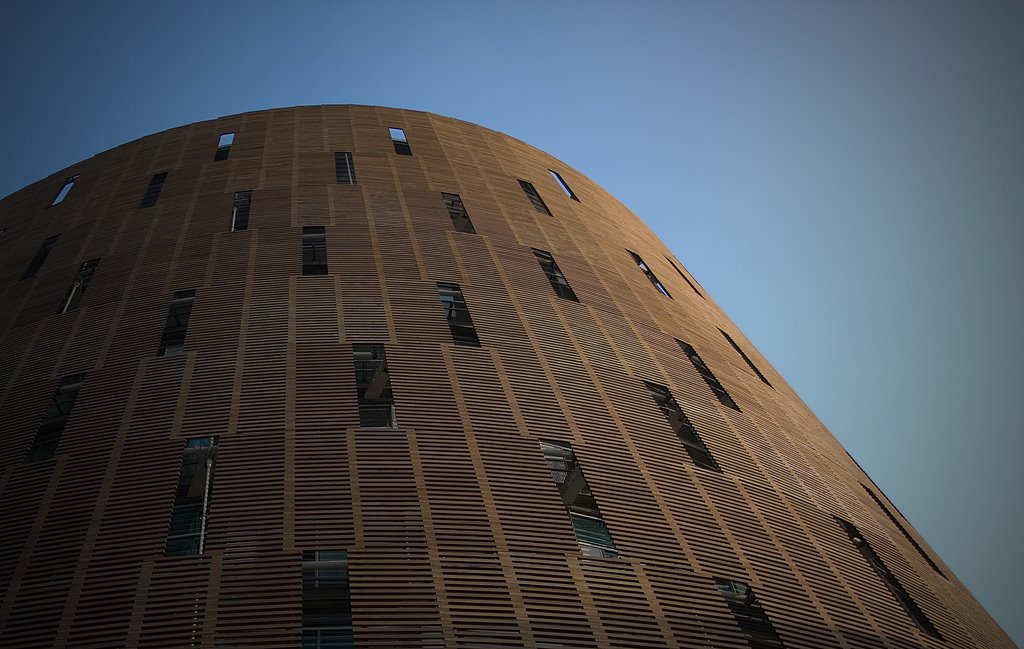
Two and a half years later, I officially belong to the Center for Genomic Regulation (CRG), which is part of the Biomedical Research Park of Barcelona (PRBB), my boss is a group leader in the CRG, also belonging to the Grupo de Reserca en Informatica Biologica (GRIB), which is part of the Instituto Municipal de Informatica Medica (IMIM), while he teaches as a prefossor at the Universitat Pompeu Fabra (UPF). All of the above institutes, groups, entities share the common roof of the building you see in the photo. In this labyrinth of names and entities, it is difficult that someone doesn't remember Karolos' words. PRBB is since last week the closest I can think to Kafka's Tower. "Das Schloss"!

Last week I was expecting a package sent by mail from a musical store in Galicia. As I had to attend a PhD thesis defense (my first as member of the tribunal) I was not at the building when the package arrived. I received a phone-call from one of the Tower's receptionist. As her name was not mentioned we cannot resist the temptation to call her "Barnabas", a strange name for a receptionist but not for a messenger in the "Tower". In fact for someone with so little efficiency and such a big mouth, "Barnabas" falls just a little short of perfect. Anyway, the message of Barnabas was that there was a package for me, Mr N. at the reception of IMIM on the first floor of the Tower. When I asked why the package was at her hands since I belonged to the CRG, Barnabas employed the most stylish of the "towerish" accents to inform me that I was Mr. N. belonging not to the CRG but to the IMIM and that I should therefore look for the package at the mailbox of the GRIB!!!

Mr. N., myself could not but feel puzzled. Like some other Mr in a different tower I thought to be working for someone else than I actually was. Upon arriving to the Tower the same afternoon I went to look for my package at the designated mailbox, as the law-respecting Mr N. I am. Not to my surprise it was not there. Nor was Barnabas. And neither was I surprised when the secretary occupying her spot -we can call her Olga- told me she knew nothing about the package, or who I was, or where I worked at. She advised me to look for the parcel at the GRIB, so I went up to the 4th floor to do so. The package was not there and the secretary of the GRIB -whose name could be Amalia, although it is not- suggested that I looked for the person responsible for purchases at the CRG, -I shall call him Gerstacker-. Although this was not a purchase that the CRG would know anything of, I went up on the 5th and after a brief conversation with Burgel, the CRG receptionist I went to look for Gerstacker. By that time I was getting close. My assistant Jeremiah -she's a girl, but "Jeremiah" IS the proper name for Mr. N's assistant- had joined me in my quest and we managed to talk to Gerstacker together. At the beginning he was reluctant in helping me. It was late in the afternoon and most of his colleagues must have been having beer at the "Herrenhof Inn" already -which could also be called Bitacora but is not, not in this story at least-. The only thing he could tell me is that he would look for it and that I should send a message to Barnabas. As I told him that Barnabas is the messenger and that it would be silly to send a message to the messenger he looked at me with an angry look so me and Jeremiah decided to go. It was late and I had flight to catch.

Needless to say I never found the package myself. It just appeared on my desk two weeks later. When I asked how it got there nobody could tell me. Neither Hans, Frieda, Pepi or the Teacher knew how it got there. I tend to think it was Galater, the one who assigned Jeremiah as my assistant but somehow I would like to think that it was not him. I 'd like to think it was Klamm. The one I am supposed to be working for and never get to meet. The one that everybody claims to know, but cannot really describe.

Standing by my desk, looking at the un-opened parcel, I could not stop thinking about my life in the Tower after 30 months. How a lot of things that sounded so clear when I came here now seemed to be completely out of reach like Klamm, or so complicated like getting a package on your desk.

I remembered another tower I had read about once and a distant relative of mine, a distant relative of all of us. Mr K. Was I to end up like him, working as a janitor instead of the land-surveyor I was once destined to be?