Sunday, August 10, 2008

fake empire


Posting is like reading books. The longer the abstinence, the greater the difficulty to resume. After a hard end of July and a great beginning of August, I find putting my thoughts in a post as hard as going back to work. Or perhaps even more, since this post comes almost a week after I came back from a great trip in Andalucia and with my "professionally-amateur" working obligations at full pace.

One might think that a long-awaited trip, with "long-time-no-seen" friends would bring back some strength to resume work. Especially somewhere between an empty flat and a half-empty lab. Well, at least I did thought so. But I was wrong.

Over the last week, I have worked my ass ("arse" Colin would have corrected me) off with the scarcest results and experienced days which achieved peaks of unprecedented futility (like last Friday's quest for a periodical pattern in some stupid cancer cells' nucleosomes, but I am sure none of you cares, why should you anyway?). The key however is not there. The key is in the fact that somehow I seem to have lost any joy in the way we (or I) work, or perhaps I am only realizing the fat that I am incapable of working as "we" and can only work as "I". It's not necessarily a bad thing, I just have to keep it as my little secret when future, "aspiring" employers of mine ask me whether I am prone to "work in a group".

The problem in this case is that this group work consists mostly of having to deal with sometimes superficial, often absurd and almost always frustratingly boring orders of my bosses, whose vision of science I start to realize that I am not sharing at all. I found myself, a distinguished citizen of a fake empire whose pillars I am responsible to built and maintain. Numbers don't add up, models fail, all orders of statistical moments have united against me, my plots' curves assume irritatingly mocking grins. On top of all that, I have to make them all look good. That is the very essence of the fake empire. Here, results are discussed before the experiment is designed, the papers written before the analysis. In the fake empire, there is no time to think. Science is like riding a bike, they say. If you stop moving, you fall.

And should my empire decline and fall, I shall fall within it. What really worries me though, is that the thought of it does not sadden me one little bit.

Tuesday, July 15, 2008

shut it down

Another week with visitors is going on at a frenetic pace. Trying to get some work done during the morning, with numbers growing increasingly stubborn and almost impossible to be put in order. Evenings are devoted to my sister and her friend who are -I hope- enjoying the city at its freshest, despite of it being July. Then, nights are starting to become that part of the day when I recur to work. My boss is officially out for the rest of the summer and his night e-mails are becoming more and more often. It is of course my fault to be reading them at 3 am.

They say that people in the Mediterranean are under-functioning throughout most of the summer. That it is rather impossible to be expecting work to be done under 40 degrees centigrade with the sea at your doorstep. And although I am a bit reluctant in admitting that generations of Greeks, Spaniards and Italians may not be wrong, I am still trying to put my numbers in order in the middle of July. At the same time I am forcing myself to share the enthusiasm of the friends who are having holiday right next to me, comfort the sadness and frustration of beloved ones that are still very far from their own vacation and cope with all sorts of internal pressure.

You see, at the side of all that, I still read the news every morning (or around noon). And most of the times they are not good. Beautiful places in Greece, suffer from drought, problems with our Slav neighbours of Northern Macedonia, corrupted politics, ignorant voters. Off the front page of the cultural section: the State Orchestra of Greek Music is to be shut down because of lack of funding. This is becoming all too much. "Memory", Sherlock Holmes once said, "is a closet with non-elastic walls. Once you have to stuff it with something, you have to get rid of something else you were keeping in." And although my memory seems to be still working quite well, I am growing more and more anxious to shut it down. And therefore stop thinking about Greek forests going dry and Greek musicians going out of work, while their minister of Culture is going on holiday with his super-rich friends.

Shutting my memory down is still two weeks away -if it even happens then. But until then, frustrated, dizzy and confused I choose to invent a new term for my memory status. I shall therefore fall into "estatization", (as opposed to "hibernation"). I 'll go into this limbo where, I am not supposed to think, or worry about all this, the corresponding of a summer marmot, only instead of sleeping I shall be dreaming awake about the beaches of Andalucia, my friends and glasses of cold beer. And I will listen to the music of the State Orchestra of Greek Music. And I plan to stay there, in my summer laziness, my "estatization", or what we Greeks would call "ραστώνη" until I feel strong enough to confront my numbers and the newspaper headlines again.

Monday, July 7, 2008

the beauty of it all


Beauty, we are sometimes told, is subjective. One cannot but turn his face away from a Picasso at the same time someone else is praising the genious of the painter. And my friend Sylvain was often irritated at the site of the "too-skinny for his taste" Keira Knighltey, hanging from my office boarder, while I have placed her photo facing him instead of me so that I avoid additional distractions. At the same time I would like to think that there are things in life that are beautiful in a completely unanimous and objective way. Images, sounds, tastes that evoke similar feelings of joy and neuronal pulses of satisfaction.

Or as my friend Filipe would put it: "Beauuuutiful"!

I thought about all this, while during a boring Monday like today, and with a lot of work running on the background, I was browsing the newspapers on the web. As most of the -not exactly countless- readers of this blog would have absolutely no hesitation in asserting, reading the papers is one of my dearest activities. I often think of it to be as important as work, simply trying to ignore the actual fact that it IS far more important than it. And although it should have been otherwise, I always look for beauty in the articles I read. theatre reviews attract my eye more than political analysis and interviews of musicians are preferred to editorials about unemployment. It so turned out this morning that politics, work, beauty and reading the papers got connected today, as I read an article about the fishermen of the Mediterranean and the future of their profession.

Besides a couple of times in a distant childhood when I joined an uncle of mine on a fishing night in the calm waters of Ancient Epidavros, I have never fished on my own, neither can I say much about it. The simple fact, however, that a 12-year old can have so much fun while participating at what someone else does for a living, can say much about the nature of that particular job. Fishing can be tough. Most of the time it's not fun. And most of times it is not done on full-moon, July nights in the beautiful, ancient bays of Argolida. On top of all that, as the fishermen of the article I was reading were pointing out, it is not even profitable anymore. Most of them are quitting or are just about to do so. The new directives of the EU impose on them the same kind of restrictions to which the big fishing fleets are subject, which makes the complications even less bearable. Getting a small boat out in the waters of Algeciras, Antibes, Astypalaia or Antalya simply doesn't pay the bills anymore.

Nonetheless, the beauty is still there. And it stroke me deeply to read what an old fisherman had to say about his seemingly un-rewarding profession. "It's the most beautiful job in the world", he said, "I would never change looking at the sun go down behind the cape of Antibes as I sail out for anything else. It may not fill my plate anymore, but it fills my heart with joy".

Sitting at my desk, overlooking that same sea, the old man was talking about, I tried to reflect about the lost beauty of what I do. And -if it doesn't sound like sacrilege- I thought it should be of the same kind of Picasso or Keira Knightley, subjective and somehow obscure to most. A beautiful equation, a beautiful thought put on paper and proven on the screen, such things are not yet completely out of reach even though everyday obligations and stupid science-management trends make them more and more distant everyday. I thought about the old man and his sea, the sunset at Antibes compensating for his daily struggle and realized that before everything else we owe it to ourselves and to science to make it as beautiful, as rewarding and as appealing as possible.

Even if it will never match the site of this small boat floating on the turquoise waters of the cote d'azur.

Wednesday, July 2, 2008

Das Schloss

It was back in September 2005, while visiting the lab for the first time. I was in Barcelona for a short stay which included an interview with my current boss(es) when two of my current colleagues kindly offered to take me to lunch. At some point the discussion came to the unusual "structure" of the Institute, which even to the ears of a Greek, accustomed to bureaucracy, sounded quite weird. People belonging to two or more Institutes at the same time, while being paid by a third one, some of the centers affiliated to the state, others simultaneously forming part of a semi-private University, most of them overlapping with each other, being reciprocally part of each other and all of them at the process of being incorporated into the Biomedical Research Park of Barcelona (PRBB, also known as the "Alcatraz of western Mediterranean").
"I am telling you it's Kafka's wet dream". My witty colleague and compatriot Karolos could not have come up with a better description of the situation.

Two and a half years later, I officially belong to the Center for Genomic Regulation (CRG), which is part of the Biomedical Research Park of Barcelona (PRBB), my boss is a group leader in the CRG, also belonging to the Grupo de Reserca en Informatica Biologica (GRIB), which is part of the Instituto Municipal de Informatica Medica (IMIM), while he teaches as a prefossor at the Universitat Pompeu Fabra (UPF). All of the above institutes, groups, entities share the common roof of the building you see in the photo. In this labyrinth of names and entities, it is difficult that someone doesn't remember Karolos' words. PRBB is since last week the closest I can think to Kafka's Tower. "Das Schloss"!

Last week I was expecting a package sent by mail from a musical store in Galicia. As I had to attend a PhD thesis defense (my first as member of the tribunal) I was not at the building when the package arrived. I received a phone-call from one of the Tower's receptionist. As her name was not mentioned we cannot resist the temptation to call her "Barnabas", a strange name for a receptionist but not for a messenger in the "Tower". In fact for someone with so little efficiency and such a big mouth, "Barnabas" falls just a little short of perfect. Anyway, the message of Barnabas was that there was a package for me, Mr N. at the reception of IMIM on the first floor of the Tower. When I asked why the package was at her hands since I belonged to the CRG, Barnabas employed the most stylish of the "towerish" accents to inform me that I was Mr. N. belonging not to the CRG but to the IMIM and that I should therefore look for the package at the mailbox of the GRIB!!!

Mr. N., myself could not but feel puzzled. Like some other Mr in a different tower I thought to be working for someone else than I actually was. Upon arriving to the Tower the same afternoon I went to look for my package at the designated mailbox, as the law-respecting Mr N. I am. Not to my surprise it was not there. Nor was Barnabas. And neither was I surprised when the secretary occupying her spot -we can call her Olga- told me she knew nothing about the package, or who I was, or where I worked at. She advised me to look for the parcel at the GRIB, so I went up to the 4th floor to do so. The package was not there and the secretary of the GRIB -whose name could be Amalia, although it is not- suggested that I looked for the person responsible for purchases at the CRG, -I shall call him Gerstacker-. Although this was not a purchase that the CRG would know anything of, I went up on the 5th and after a brief conversation with Burgel, the CRG receptionist I went to look for Gerstacker. By that time I was getting close. My assistant Jeremiah -she's a girl, but "Jeremiah" IS the proper name for Mr. N's assistant- had joined me in my quest and we managed to talk to Gerstacker together. At the beginning he was reluctant in helping me. It was late in the afternoon and most of his colleagues must have been having beer at the "Herrenhof Inn" already -which could also be called Bitacora but is not, not in this story at least-. The only thing he could tell me is that he would look for it and that I should send a message to Barnabas. As I told him that Barnabas is the messenger and that it would be silly to send a message to the messenger he looked at me with an angry look so me and Jeremiah decided to go. It was late and I had flight to catch.

Needless to say I never found the package myself. It just appeared on my desk two weeks later. When I asked how it got there nobody could tell me. Neither Hans, Frieda, Pepi or the Teacher knew how it got there. I tend to think it was Galater, the one who assigned Jeremiah as my assistant but somehow I would like to think that it was not him. I 'd like to think it was Klamm. The one I am supposed to be working for and never get to meet. The one that everybody claims to know, but cannot really describe.

Standing by my desk, looking at the un-opened parcel, I could not stop thinking about my life in the Tower after 30 months. How a lot of things that sounded so clear when I came here now seemed to be completely out of reach like Klamm, or so complicated like getting a package on your desk.

I remembered another tower I had read about once and a distant relative of mine, a distant relative of all of us. Mr K. Was I to end up like him, working as a janitor instead of the land-surveyor I was once destined to be?

Tuesday, June 24, 2008

today

Then take me disappearin' through the smoke rings of my mind,
Down the foggy ruins of time,
far past the frozen leaves,

The haunted, frightened trees,
out to the windy beach,

Far from the twisted reach of crazy sorrow.
Yes, to dance beneath the diamond sky with one hand waving free,
Silhouetted by the sea,
circled by the circus sands,

With all memory and fate
driven deep beneath the waves,

Let me forget about today until tomorrow.

Bob Dylan
Mr. Tambourine man

Monday, June 23, 2008

a bloomsday of one's own


June 16th, 1904 was probably a day like everyone else in the lives of those who did not have their first born child seeing its first light on that day, or did not lose a beloved one or got married to their love of their life. It was probably a day like everyone else in the lives of a lot of people. Fortunately for us, it was not an ordinary day in the life of James Joyce, who had his first date with Nora Barnacle, on that same afternoon. As Nora was to become his wife and lifetime companion, that 16th of June, 1904 assumed a special role in Joyce's life and this is how it ended being probably the most famous, ordinary day in the history of literature. Joyce's "Ulysses", acclaimed by many as the greatest novel of all time, takes place in Dublin during that day.

June 16th of June is nowadays celebrated by Joyce's fans all over the world and his Irish compatriots in particular. And since one of "Ulysses"' main characters is called Leopold Bloom, the term "Bloomsday" has been coined for this literary anniversary. The "real" Bloomsday, inside the novel, is a full day from dawn until early the following morning, a single 24-hour trip through the early 20th century Dublin, but is at the same time a long journey in the lives of many people evolving in parallel. An "Odyssey", as the title of the book suggests.
I still haven't manage to read "Ulysses", although I once started it. I hope I do it one day, but until then I happen to think about how one's day can turn into a full "Oddysey" in the way it happened to Leopold Bloom's on June 16th, 1904.

Last Tuesday, June 17th 2008, one day and 104 years after Bloomsday, I thought I had one of my own. The complete recollection of its events seems somewhat impossible right now, mostly because I feel more tired than what I felt a week ago. In any case, none of the occurrences of last Tuesday really deserves to be mentioned. It is mostly their unstoppable flow that makes me think back to it as my own "Bloomsday" and although there is no correspondence of any of the incidents with an episode from the Homeric epic, my whole 24 hour day could qualify as a minor ordeal. It more or less involved an early waking up, after having spent the previous night reading a PhD thesis, judging that exact same thesis as a member of a committee, socializing with unknown people after the thesis defense was over -probably the hardest part-, rushing back to the flat under the rain (on June 17th!), packing for a short trip that sounded nothing like fun, then straight to the lab only to spend 30 minutes looking for a lost package (a story whose weird literary connotations deserve a post of their own, soon to follow) and the rest couple of frenetic hours organizing work with Sonja to be done during my absence. Run to the train station, then to the airport, check-in, have a snack while watching Italy beat France on some big screen, board the plane, fly to Greece, arrive there in the middle of the night, bus, taxi, get to my parents' house around 4 a.m. and to bed around 5.30.

I know it doesn't sound a bit like an Odyssey and I can reassure you it wasn't. But neither would "Bloomsday" feel like one had it not been for the genious of Joyce. And in fact, it would have been one of "those ordinary days" for me as well had it not been on June 17th, one day after the "real" Bloomsday. Funny how a seemingly insignificant date of a young promising writer at the turn of the 20th century, ends up affecting my life 104 years later.

Sunday, June 15, 2008

my grandma has a say


Another cloudy Sunday, with Greece already eliminated from the Euro and me instead of following my boss' advice ("work, work and then work some more"), am reading the Sunday papers in four different languages.

On the news since last Friday, the decision taken by the Irish government to refuse to ratify the Treaty of Lisbon (a slightly "made-up" version of the EU Constitutional Treaty), after the negative vote of the Irish people. It is somehow striking how this treaty (or its predecessor) fails to be ratified by any state which decides to leave it up to its people through a process of vote. It happened in France and the Netherlands back in 2005, it happened again in Ireland. On the other hand, the Treaty has been approved by most of the EU members, which chose to ratify it through the vote of the parliament, bypassing direct voting. However, -and somehow misleadingly- the press throughout this frustrated continent puts the blame on the Irish. For what? For simply letting the people decide.

On this "hot" subject, today on the news, I read "funny" articles (use of the term "funny" in order to avoid other, bitterer ones). Articles like this one in Greece's Kathimerini, or this in Spain's El Pais. Articles which suspiciously focus on an "interesting" (I hope you bear with me with these quoted terms) concept of "minorities" deciding over the majorities. It sounds pretty reasonable the way I summarized it (and carefully placed it carefully in between quotation marks) but is it? Is it really? What Europe's most distinguished columnists call a minority is the small margin of more or less 110.000 votes with which the Irish voted in favour of not ratifying the treaty. These 110.000 votes -they claim- stand between the fulfillment of the will of 500 million Europeans. This immense majority, which -always according to them- has been holding its breath with utter anxiety until the Lisbon Treaty is finally put forward.

I know most of the people don't care reading the papers that much, perhaps because the sun is brighter in Greece or in other parts of Spain or even in Poland and they prefer a Sunday afternoon walk instead of bothering to read this kind of crap (there you have it, no quotation marks any longer). But what these people are implying by talking about "minorities" is that we should no longer leave decisions like these to the people. Everyday people -they say- lack information, they vote on the grounds of personal discontent, they are too ignorant to realize what is good for them, too distracted by the fear of economic depression to reason the true advantages that this treaty will offer them. Instead we should be taking these decisions more "democratically". Through parliamentary vote, with less room for fuss on indymedia, preferentially on an evening session, if possible on a football night. You see, our representatives know more. After all it was us who voted for them so why shouldn't we trust them? I mean honestly, would you prefer that the future of our continent be decided by your poor grandmother or by your well esteemed "congressmen"?

We are entering dangerous ground here. I know democracy is supposed to be the "lesser bad" of our alternatives but once we chose it we might as well stick with it. My "representatives" will not be here in four years to explain what has been going wrong with Europe. The ones who chose to switch to the Euro six years ago (the period with the greatest increase in prices Greece has experienced since WW2) are all well off, pretending nothing happened. Morevoer, I have to admit I had little idea that the Treaty has been ratified already by the parliaments of 17 states. Could this be because I am not being "informed" enough so that I can have an opinion about my constitution? Or is it perhaps that it was something so insignificant our leaders -AND leading columnists- did not want to bore us with? How come such a big discussion, exchange of arguments (even as lame as the aforementioned ones) is being raised now, after the Irish "NO"? Isn't this a sign that democracy is still breathing, and that the debate starts when somebody has a different opinion?

The defenders of the "majorities" should have no fear. Now that the people are suddenly interested in the Treaty, they can try to "inform" them better. If they think they don't evaluate the Treaty's text on solid grounds, they can explain all the "benefits" that come with it. After all it is their job. I mean, the Irish "fools" screwed up with Europe's dream but there is still hope for the rest, isn't there? Please Sr. Carnero, Mr. Konstantaras, could you explain to me and my poor grandmother what is really the best for us instead of putting the blame on the Irish?

I promise to be very careful while listening to your solid arguments. But as regrading who should finally decide about my Constitution, I beg to differ and for once more I 'll choose to be the "radical" one, the "undemocratic", the "minority" supporter. And yes, if you ask me, I prefer my grandmother decides what's best for her. After all, if something goes wrong, she 'll need no one to be blame but herself.

Tuesday, June 10, 2008

apparently still not summer


I saw the president this morning
taking breaths of solid rain
as the economy was growing,
on its usual way down the drain.
He waved and smiled, so reassuring,
wearing his Sunday purple cape
as he jogged around in his helmet
for fear that his thoughts might escape.

Over there, there was a silver marmot
stuffed inside a flying saucer's exhaust pipe,
you would like to think about it
but the time may not be ripe.
It seemed to be dreadfully disgusted
and would prefer to go back to bed
as the Martians flew to warmer climates
through clouds that were painted lead.

By the rotten seashore the dizzy bees
are buzzing to find their way back home,
I meant to ask them for directions
but felt I' d better let them roam.
The professor watched them flying about
preparing his next Nobel-winning speech
as the slave ship had just run aground
and all hope was out of reach.

Now, there's an unemployed programmer
and he's sculpting pink balloons
with his square head uncovered
slightly exposed to the monsoons.
His subconscious is so structurally different
from most fellas you would meet
on a random Tuesday morning
at the side of this sweaty street.

And, me, I was only having breakfast,
meditating in the haze,
when I tried to invent a tragic scene
going on in some man's mind's maze.
Then the early fog got thicker
and the actors staged a balcony,
as the neighbours stood there with indifference
and pretending agony.

today

-Contáselo con todos los detalles -dijo Oliveira.
-Oh, una idea general es bastante -dijo Gregorovius.
-No hay ideas generales -dijo Oliveira.

Julio Cortázar

Rayuela


Friday, June 6, 2008

Intuition

Over the last few days, I have been getting fewer sleep, less rest and more stress than usual. The reason has to be attributed rather to a tight schedule of pre-determined activities, than actual work. Which can be quite frustrating especially when you realize it is 7 pm and you are still at the lab without having have done anything useful apart from making a slide look nicer for a presentation everyone will forget ten minutes after they enter the room. On the side of all this, the usual fanfare of meetings, talking to people about your work, more communicating than actually working. Over the years, I have slowly developed my own personal alerts for when this sort of situation becomes increasingly unbearable, the most alerting of which is an increasing frequency of tiny memory failures. I tend to think I -still- have quite a good memory, therefore being unable to recall the director of a film I saw two weeks ago or the name of a street in Barcelona becomes a sort of annoying if not warning that something has been cryptically occupying my precious neurons to an extent greater than what I should have allowed for. And it gets really disturbing when you combine it with a feeling that something does not really fit, that there is something there in front of your nose, the right result, nature winking at you and you simply cannot see it because you lack concentration.

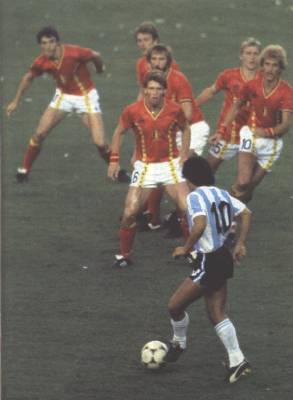
During the past frustrating week, the only thing that kept me going through another attack of this fragmentary universe of demands was the thought that in the end of it all, at the end of this week, I could seek the tranquility I 've been longing for in the beauty of my favourite game. Euro 2008 starts in less than 6 hours and a month full of football sounds as reassuring for my tormented mind as his blanket was for Linus, or a teddy bear for a little child. In the case of the little child inside of me, my favourite toy is a football and my most subconscious urges lead me to connect it with practically everything. Therefore, upon facing a "sea of troubles", I could not help but remembering this beautiful photo, which used to hang from the wall of my student-years bedroom. Maradona controlling the ball with the interior of his supreme left foot, facing half of the Belgian national team in the semifinal of the World Cup in 1986. Against this "sea of defenders" he is calm. On the other hand, it is his aspiring "troubles" who look troubled, if not horrified. Needless to say, a bit after this shot was taken, Diego went through all six of them, or even more, scoring one of the greatest goals in the history of football. That was his way to get out of trouble back then. And even if he didn't manage that well with other sorts of trouble, (sneakier, less apparent and without the "fairytale"-like clarity of a football opponent) he still remains one of my greatest heroes.

I was thinking about that goal against Belgium, slightly under-rated, although in my humble opinion equally magnificent to the famous one against England in the quarter-final of the same tournament. Then, in one of my -frequent- breaks in front of my plots, I decided to look it up in youtube. I came up with this video.

Contrary to the usually sloppy, biased and unworthy goal compilations one may find in youtube, this one is probably the best I can think of. It goes on for 22 minutes with a selection of 50 legendary goals and although some are still missing I cannot but congratulate the compiler for making my Friday a bit more bearable. As the countdown from 50 to 1 was developing, my satisfaction was growing in a rather egocentric way, as I was realizing that simply by looking at the name of the player and before even the goal was broadcast, I could guess which would the goal be. So, I anticipated Dennis Bergkamp's sublime move round Dabizas in a match of Arsenal against Newcastle, I watched Maradona pierce the Belgian defense, Roberto Carlos swerving the ball to an unprecedented angle in "that free-kick" against France, I remembered a beautiful shot by Enter in the World Cup of 82 against the Soviet Union, which I have only seen on video. And then I saw once again what should be the simplest greatest goal of all time. Brazil's 4th in the final of the World Cup of 1970 against Italy.

It doesn't look like a great goal at first, the ball being passed around with the coolness and indifference of a friendly game. The score is 3-1 already and we are well into the final quarter. But as with great works of art, it takes sometime to appreciate the beauty of this one, as the whole team passes the ball around, the opponents retreating in fear of the calmness before the storm. Tostao wins the ball back on the left side line, passes to Piazza, Piazza to Clodoaldo. Clodoaldo makes fun of four Italians who commit the mistake to approach, passes to Rivelino, he stays on the left swerving the ball down the line to Jairzinho. Then a thunderous short run parallel to the box, passes to Pele and there you have it. The goal starts here. By the moment Pele receives the ball everything has been decided already. The Italian defense is out of balance, as the overload of Brazil's attack is forced on the left side. Pele has a space wide open to his right but doesn't make any move. He just stands there facing the goal with the ball at his feet. Carlos Alberto has started his run on the weak side, comes into the TV frame by the time the Italians can only stare at him, as he receives a seemingly meaningless pass by Pele. A perfect shot to the far post. 4-1.

A lot have been said about this goal, mostly having to do with Pele's blind pass. The great Brazilian, when repeatedly asked about it, always gave the same answer. "I did not seem him coming, I heard his footsteps." Arrogant by nature, Pele shares here a part of the truth. It's only natural that he could not have heard Carlos' footsteps in the tumult of 120.000 fans in the Azteka Stadium. However, he cannot but have thought that the natural course of things would be this. That the right back would make the run on the weak side to catch the defense off-guard. His pass is the simple proof that in football as in every human activity, there is a constant need for blending thought with intuition.

I was thinking about all this when I realized that perhaps this blending is what I have been lacking over this last frenetic weak. And that maybe I need to add a bit more of intuition in my thoughts, instead of simply weighing down my poor, limited memory with loads of information.

Or maybe I am doing it again, connecting football to practically everything.